
Table of Contents
- Button Nose Quick Check
- What Is a Button Nose?
- Button Nose vs Snub Nose vs Celestial Nose
- Can a Button Nose Be Wide or Big?
- How to Check a Button Nose in Photos
- Glasses and Makeup Tips for a Button Nose
- When to Use an AI Nose Shape Detector
- How to Self-Check Whether Your Nose Is Button-Shaped
- Frequently Asked Questions
Searches for button nose usually come from one small but confusing question: is a rounded, compact nose automatically a button nose, or is it snub, bulbous, celestial, or simply photographed from an angle that makes the tip look rounder? The useful answer is structural. A button nose is defined less by overall size and more by a soft rounded tip, a balanced bridge, and a gentle profile that looks compact without an obvious hook, hump, or heavy bulbous tip.
Button Nose Quick Check
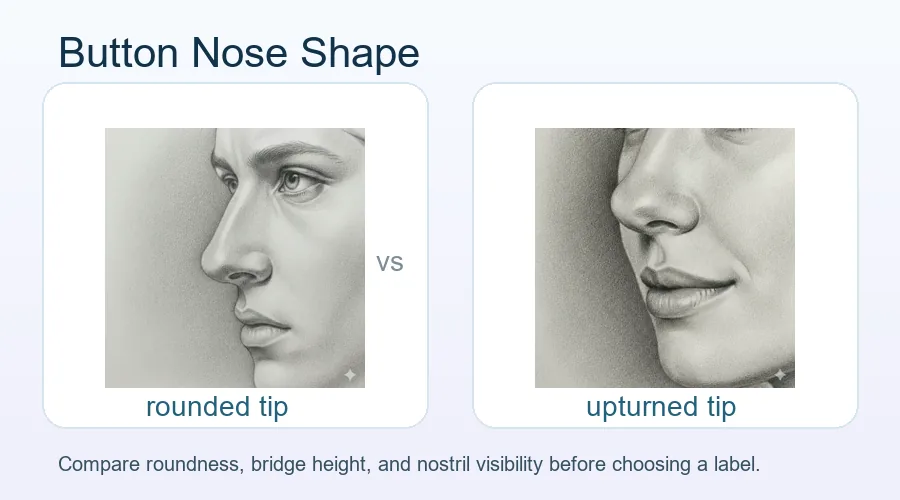
Use these visible clues before choosing the label. They focus on shape, not beauty standards.
| Feature | Button nose shape | What to compare |
|---|---|---|
| Tip shape | Rounded, soft, and compact | Compare with a wider bulbous tip that looks heavier or less defined |
| Bridge | Usually low to medium and balanced | A very high or convex bridge may point toward Greek, Roman, or aquiline types |
| Tip angle | Neutral to gently upturned | Strong upward rotation with visible nostrils is closer to snub |
| Overall impression | Small, neat, and youthful | Do not rely on one close selfie; lens distortion can shrink the bridge |
A button nose can be petite, but small size alone is not enough. The rounded tip and soft profile are the main clues.
What Is a Button Nose?
A button nose shape is a nose with a rounded tip, modest projection, and a compact look from the front and side. The bridge is usually straight or softly curved rather than sharply convex. The lower nose looks neat, not broad and heavy, and the tip has a gentle rounded finish instead of a pointed or hooked end.
The name comes from the impression of a small rounded button at the end of the nose. That does not mean every button nose is tiny. Some people have a wider button nose, a stronger bridge, or a slightly upturned tip and still fit the category because the dominant feature is a soft, rounded tip.
Strongest clue
The tip looks rounded and compact without the heavy fullness of a bulbous nose.
Common overlap
Button noses often overlap with celestial or slightly upturned noses, but the rotation is usually softer.
Use button nose as a descriptive label, not a ranking of attractiveness. It is one natural variation among many nose shapes.
How to Check a Button Nose in Photos
Use one front photo and one side-profile photo taken from a normal distance. The front photo shows whether the tip is rounded and whether the base is narrow, medium, or wide. The side photo shows bridge height, projection, and whether the tip is neutral, gently lifted, or strongly upturned.
Avoid very close phone selfies. Wide-angle lenses can make the center of the face look larger while shortening the bridge, which can make many noses appear more button-like than they are. Step back, keep the camera at eye level, and compare several photos in natural light.
Front view
Look for a rounded lower nose and a soft tip that does not dominate the whole face.
Side view
Check whether the bridge is smooth and the tip is rounded rather than hooked or sharply pointed.
If only your close selfie looks like a button nose, retake the photo from farther away before deciding.
Glasses and Makeup Tips for a Button Nose
For glasses, adjustable nose pads or a comfortable keyhole bridge can help if a compact bridge makes frames slide. Medium-size frames usually balance a soft rounded nose better than very tiny frames that repeat the same scale. A slightly higher bridge placement can add visual length without hiding the nose.
For makeup, subtle contour along the bridge can add definition in photos, while a tiny highlight on the bridge rather than the tip keeps the profile balanced. If you like the rounded look, keep the contour soft and avoid sharp lines that fight the natural shape.
Frame choice
Try frames that sit securely and add a little vertical structure without pressing on the tip.
Contour goal
Use light definition if desired, but keep the rounded tip looking natural.
Styling is optional. A button nose does not need correction; these tips are for proportion control and personal preference.
When to Use an AI Nose Shape Detector
An AI nose shape detector is useful when you want a second opinion after your own photo check. It can compare the visible bridge, tip, nostril base, and profile clues against several nose-shape categories instead of making you choose from one label too early.
For best results, upload a clear front-facing photo with natural lighting, no heavy filters, and no extreme head tilt. If you are deciding between button and snub, add a side-profile photo to your own comparison notes because tip angle is easier to judge from the side.
Best input
Use a clear, eye-level photo from a normal distance.
Best use
Treat the result as a classification aid, not a fixed judgment about your face.
AI can help with labels, but your real face may combine traits from several categories.
How to Self-Check Whether Your Nose Is Button-Shaped
Run through these steps before using one label everywhere.
- Take one front photo and one side photo in natural light from a normal distance.
- Check whether the nasal tip is rounded and compact rather than pointed, hooked, or heavy.
- Compare the bridge: button noses usually have a smooth low-to-medium bridge, not a pronounced hump.
- Check nostril visibility. If the tip is strongly upturned and nostrils show clearly, compare with snub nose.
- If the tip is round but also very wide or full, compare with bulbous nose before deciding.
- Use the AI detector as a second opinion after you make your own structural check.
The goal is a useful descriptive label, not a beauty score.
Frequently Asked Questions
References and notes
- External nose landmarks such as the nasal dorsum and nasal apex are described in plain-language anatomy resources from Cleveland Clinic. Cleveland Clinic nose anatomy
- Population-level differences in nares width and alar base width have been studied in relation to climate adaptation. PLOS Genetics nose shape study
- Cosmetic sources often discuss nasal tip, nostril, and bridge changes; this guide uses those terms only for visual identification, not medical advice. ASPS rhinoplasty overview
Last updated: June 11, 2026