
Contents
People often search for nose bridge types when glasses do not fit, when a side profile looks different from the front view, or when a nose-shape guide feels too broad. The bridge does not tell your whole nose type, but it is one of the landmarks that explains why a nose can look straight, flat, prominent, or soft from different angles.
High vs Low Nose Bridge: Quick Comparison
Use this table as a first pass, then check the detailed steps below. Bridge height is relative to your face, not a beauty score.
| Bridge type | Common visual clue | Glasses clue | Related searches |
|---|---|---|---|
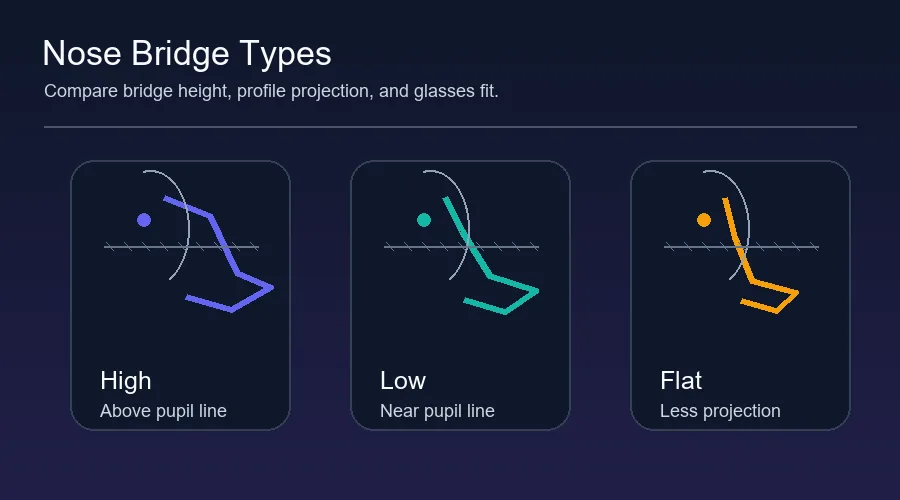
| High nose bridge | Bridge starts above the pupil line and projects clearly between the eyes. | Standard frames often sit securely without touching the cheeks. | high nose bridge, high bridge nose |
| Low nose bridge | Bridge starts near or below the pupil line and may look smoother from forehead to nose. | Frames may slide down or rest on the cheeks when smiling. | low nose bridge, low bridge nose |
| Flat nose bridge | Upper bridge looks broad, low, or less raised in front and side views. | Low-bridge fit or adjustable nose pads may feel more stable. | flat nose bridge, low nasal bridge |
| Medium bridge | Bridge sits between the two patterns; profile and eyewear clues may be mixed. | Adjustable pads can matter more than the label. | nose bridge types, bridge of nose |
If the bridge changes suddenly after injury, infection, or surgery, treat it as a health or medical question and ask a qualified clinician rather than relying on a cosmetic guide.
Where Is the Bridge of the Nose?
The bridge of the nose is the upper structural area between the eyes. Anatomy references describe the nasal bridge as a saddle-shaped region that includes the nasal root and the lateral upper nose, close to the inner corners of the eyes.
For self-checking, look for the part of the nose that begins below the forehead and before the softer cartilage of the mid and lower nose. In photos, the bridge is easiest to judge from a straight-on mirror view and a relaxed side profile.
Nasal root
The highest transition point where the nose begins under the brow or glabella area.
Bridge line
The visible slope or projection running down from between the eyes.
Profile projection
How much the bridge stands away from the face in side view.
Pupil line
A simple mirror reference for deciding whether the bridge begins above, at, or below the pupils.
Do not classify your whole nose from the bridge alone. Tip shape, nostril visibility, bridge width, and profile curve all matter.
The Main Nose Bridge Types
A high nose bridge usually appears more defined or angular because the upper bridge projects farther from the face. A low nose bridge appears flatter or softer because the bridge starts lower or has less projection near the eyes.
A flat nose bridge is often discussed together with a low bridge, but the words are not always identical. Low describes vertical position; flat describes projection and contour. Many people have a low-but-not-flat bridge, or a flatter bridge with a visible side-profile slope.
High bridge
More visible upper structure; often pairs with a sharper side profile.
Low bridge
Lower starting point near the pupils; often pairs with wider cheekbone interaction in eyewear.
Flat bridge
Less raised upper contour; may need eyewear with larger pads or low-bridge fit.
Broad bridge
Width is the main feature, even if the bridge is not especially low.
Ethnicity can influence average bridge patterns, but there is wide variation within every population. Use individual fit and proportions instead of stereotypes.
How to Tell If Your Nose Bridge Is High or Low
Stand in front of a mirror with your face relaxed and eyes level. Find where the hard upper bridge begins, then compare that point with your pupils. If it starts clearly above the pupils, the bridge is usually high or standard; if it starts at or below the pupils, it is usually low-bridge territory.
Next, check a side photo taken at eye level. A high bridge tends to create a clearer outward line between the eyes and the middle nose. A low bridge tends to look smoother from forehead to nose, though lighting can exaggerate or hide the contour.
Mirror test
Compare the top of the bridge with the pupil line.
Finger test
Hold a finger horizontally at pupil level and notice whether the bridge meets it.
Side-profile test
Use a neutral side photo, not a selfie from above or below.
Glasses test
Frequent slipping, cheek contact, or lens tilt can suggest low-bridge fit needs.
Photo angle can mislead you. Use daylight, a level camera, and no strong beauty filter when comparing bridge shape.
Why Nose Bridge Type Matters for Glasses
Eyewear brands often separate standard bridge fit from low bridge fit because the same frame can sit very differently on different noses. A low bridge fit usually adds more lift, grip, or cheek clearance so the frame does not slide down the face.
For a high bridge, standard frames may work well, but bridge width still matters. For a low or flat bridge, adjustable metal nose pads, larger pad arms, lighter frames, or low-bridge fit designs are often more comfortable than fixed plastic pads.
If frames slide
Try low-bridge fit, lighter frames, or adjustable nose pads.
If frames pinch
Check bridge width; the frame may be too narrow even if your bridge is high.
If lenses touch cheeks
Look for more pad lift or less lens tilt.
If one side sits higher
Have the frame adjusted before blaming your nose bridge.
Bridge labels help, but comfort is the final test. Try frames while smiling, looking down, and moving your head.
How Nose Bridge Relates to Nose Shape
Bridge type supports nose-shape identification, but it does not replace it. A straight nose can have a high or medium bridge; a flat nose often includes a lower bridge and broader upper contour; a roman or aquiline nose is more about side-profile curve than bridge height alone.
If you are trying to identify your full nose shape, start with the bridge, then compare tip rotation, nostril visibility, bridge width, and profile curve. The site’s nose-shape guide and detector are better for the complete classification.
Bridge height
Helps explain high, low, or flat upper-nose appearance.
Bridge curve
Helps separate straight, roman, and aquiline profiles.
Tip rotation
Helps separate snub, button, and upturned noses.
Nostril visibility
Adds front-view evidence that bridge height cannot provide.
Use this page as a bridge-specific companion to the full nose-shape guide, not as a duplicate of it.
High Nose Bridge vs Low: Check Three Clues
When people compare nose bridge types, high and low usually describe a relative position, not a medical measurement. Start at the nasal root, then compare side projection and the way frames sit on the face.
Use the same relaxed angle for each clue. A close selfie can enlarge the center of the face, while a low camera can hide the transition between the brow and the bridge.
1. Starting position
Compare where the bridge begins with the pupil line, without raising your eyebrows.
2. Side projection
Look at a level side profile to see whether the upper bridge has clear outward projection.
3. Frame contact
Sliding frames or cheek contact can suggest a low-bridge fit need, but frame width and adjustment matter too.
Use these clues to describe appearance or eyewear fit; they do not define ancestry or your complete nose shape.
Simple Self-Check Steps
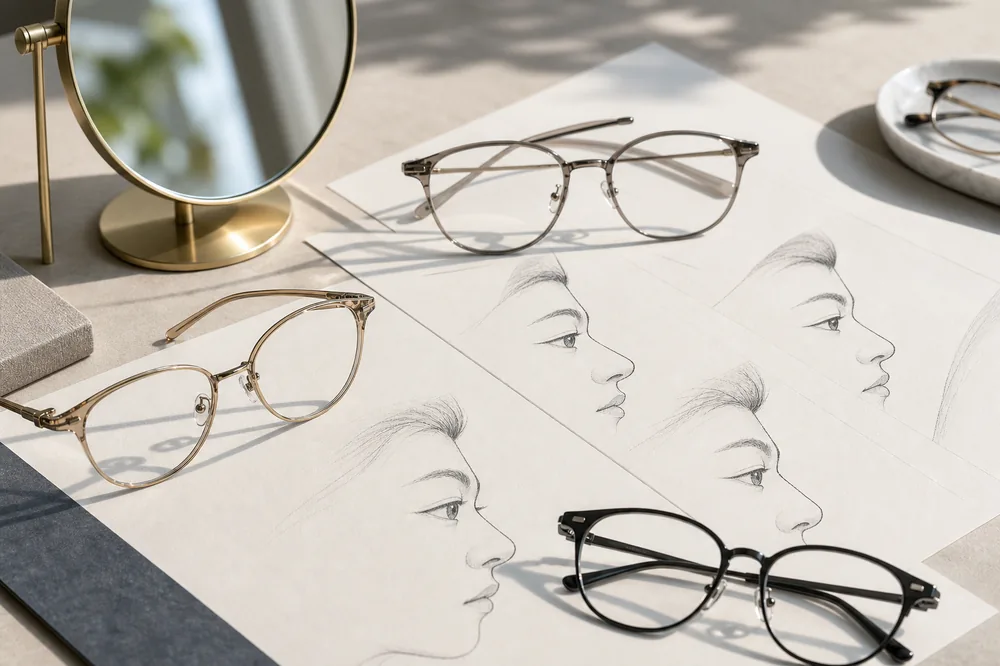
Use these steps before you compare yourself with nose-type examples.
- Take one front photo and one side photo at eye level in natural light.
- Mark the pupil line mentally and locate where the bridge begins.
- Note whether your current glasses slide, pinch, or touch your cheeks.
- Compare bridge height separately from bridge width and tip shape.
- Use the full nose-shape guide if you want the complete nose type.
This self-check is for appearance and eyewear fit only. It is not a medical diagnosis.
Nose Bridge FAQ
References
- The NIH Elements of Morphology describes nasal bridge anatomy and nearby landmarks. NIH Elements of Morphology
- Mayo Clinic explains that the nose is supported by bone at the bridge and cartilage toward the front. Mayo Clinic
- Warby Parker describes practical low-bridge and standard-bridge eyewear fit signs. Warby Parker
Last updated: August 13, 2026