
Table of Contents
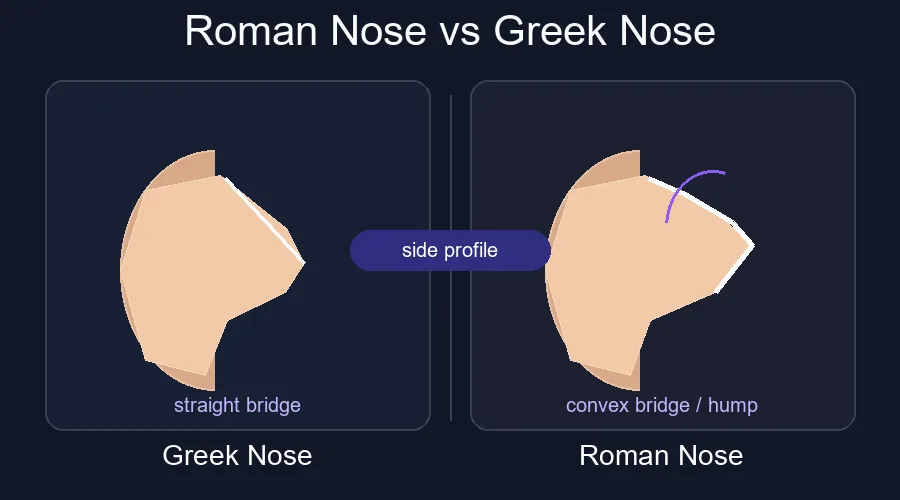
Searches for Roman nose vs Greek nose usually come from one real problem: both terms sound historical, both describe the bridge, and many people use them loosely. The simplest difference is the line you see from the side. A Greek nose is straight and even, while a Roman nose has more projection and a convex bridge. This guide gives you a clean comparison chart, practical mirror checks, and the common edge cases that make people confuse Roman, Greek, and aquiline noses.
Roman Nose vs Greek Nose Comparison Chart
Use this chart first. It separates the two shapes by visible anatomy rather than vague beauty labels.
| Feature | Greek Nose | Roman Nose | What to check |
|---|---|---|---|
| Bridge line | Straight or nearly straight | Convex, raised, or humped | Look from the side, not a close selfie |
| Dorsal hump | Absent or very subtle | Often visible at the bridge | Check whether the profile line rises then drops |
| Tip direction | Neutral and balanced | Neutral to slightly downward | The tip alone does not decide the type |
| Overall impression | Clean, smooth, classical | Strong, prominent, sculptural | Compare the whole profile, not one angle |
| Common mix-up | Straight nose | Aquiline nose | Aquiline usually has a longer flowing curve |
The Side-Profile Difference
The side profile is the most reliable way to compare a Roman nose and a Greek nose. From the side, a Greek nose forms a clear, continuous line from the radix, or nose root, down toward the tip. There may be natural texture, but the bridge does not rise into a noticeable hump.
A Roman nose has more bridge prominence. The profile line often pushes outward at the upper or middle bridge before moving toward the tip. This raised area is often called a dorsal hump. It can be subtle, but it changes the silhouette: the nose reads as stronger and more projected.
Best viewing angle
Use a true side photo at arm's length. Wide-angle selfies exaggerate projection and can make a Greek nose look Roman.
Most useful clue
Trace the bridge line visually. Straight line points to Greek; outward curve or hump points to Roman.
Do not classify your nose from a front photo only. The bridge profile is what separates these two labels.
What Counts as a Greek Nose?
A Greek nose is essentially a straight nose. The term comes from the straight, idealized profiles often seen in ancient Greek sculpture, but on real faces it simply means the bridge is smooth and uninterrupted. The bridge does not have a strong bump, and the tip usually sits in proportion with the rest of the face.
A Greek nose can be narrow, medium, or slightly broad. Width does not define the type. The defining trait is the bridge line. If your nose looks straight from the side but the tip is rounded, slightly pointed, or softly upturned, it may still be a Greek or straight nose if the bridge remains even.
Likely Greek nose
Bridge is straight, tip is balanced, and there is no visible dorsal hump in side profile.
Not necessarily Greek
A front-facing narrow nose can look straight, but the side view may reveal a Roman or aquiline curve.
On this site, Greek nose and straight nose are treated as closely related labels.
What Counts as a Roman Nose?
A Roman nose is defined by a prominent bridge. In many cases, the side profile shows a convex line, a dorsal hump, or a raised bridge that creates a bold silhouette. The tip can be neutral or slightly downturned, but the bridge is the main feature.
Roman does not mean unattractive or extreme. Many Roman noses are subtle: the hump may be visible only from one side or under certain light. The term is most useful when you are comparing bridge structure for styling, contouring, eyewear fit, or explaining your nose shape before a rhinoplasty consultation.
Likely Roman nose
The bridge is the dominant feature, with a visible outward curve or hump in profile.
Common styling note
Frames with a lower or adjustable bridge can sit more comfortably and avoid pressing on the raised area.
A Roman nose can overlap with an aquiline nose, but Roman usually sounds more angular or hump-focused.
Roman vs Aquiline vs Greek Nose: Where the Confusion Happens
Aquiline noses sit between many Roman and Greek comparisons because the word also describes a curved bridge. The difference is the quality of the curve. Aquiline usually means a longer, flowing, eagle-like arc. Roman usually implies a stronger bridge or a more noticeable hump. Greek means the bridge line is straight.
If your bridge is mostly straight but has a tiny bump, the best label may be straight with a small dorsal hump rather than fully Roman. If the bridge has a long graceful curve without an abrupt bump, aquiline may be more accurate. If the bridge rises sharply then drops, Roman is usually the clearer label.
Greek
Straight bridge, balanced tip, minimal curve.
Roman
Prominent bridge, convex profile, often a dorsal hump.
Aquiline
Longer flowing curve, sometimes with a slightly downward tip.
Hybrid features
Many real noses combine a straight upper bridge with a small hump, or a Roman bridge with a soft tip.
Use labels as descriptive shortcuts, not as beauty rankings.
Makeup, Glasses, and Photo Tips for Each Shape
For a Greek nose, styling usually works best when you preserve the clean center line. A light highlight down the bridge is enough for makeup; heavy contour can make a naturally balanced profile look harsher in photos.
For a Roman nose, contour should be subtle and targeted. If you want to soften a bridge hump, use a matte shade only on the raised area and blend carefully. For glasses, adjustable nose pads and frames that do not sit directly on the hump are often more comfortable.
Photo tip
Use a portrait lens or step back from the phone camera. Close wide-angle shots can exaggerate bridge projection.
Confidence tip
A prominent profile can be a strong facial feature. The goal is accurate vocabulary, not hiding your face.
If you are evaluating your nose for medical or surgical reasons, use this guide only as preparation for a qualified professional consultation.
Greek Nose From the Side vs Roman Nose: A Practical Example
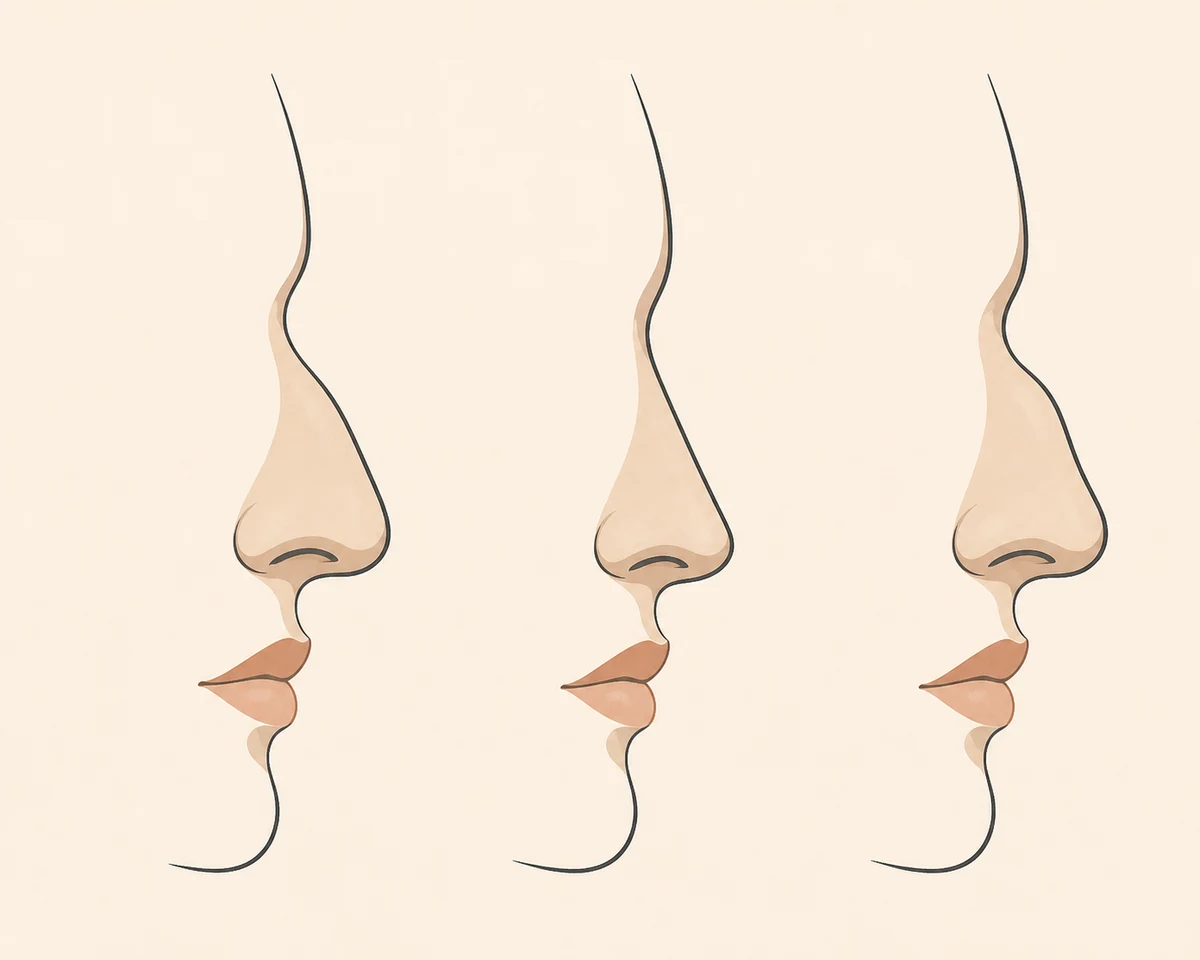
The clearest way to compare a Greek nose from the side with a Roman nose is to follow the bridge line from the root to the tip. A Greek-like profile usually stays straight; a Roman profile usually shows stronger forward projection or a convex rise.
A long, smooth curve can overlap with an aquiline description, while a small hump can appear on an otherwise straight nose. Real features often sit between labels, so use the table as a vocabulary guide rather than a verdict.
Straight bridge line
The Greek comparison point is a continuous line with little visible break from root to tip.
Convex rise
The Roman comparison point is a stronger outward curve or dorsal hump in the side silhouette.
Long smooth curve
A flowing curve may fit aquiline vocabulary better than a short, distinct Roman hump.
Check the same lighting and camera height for both views. Do not use celebrity labels as a substitute for observing your own profile.
How to Check Whether You Have a Roman or Greek Nose
Use this simple process before relying on a single label.
- Take one side-profile photo in natural light with the camera at eye level.
- Trace the bridge line from the top of the nose to the tip. If it stays straight, Greek or straight nose is likely.
- Look for an outward rise or dorsal hump. If it changes the silhouette, Roman nose is more likely.
- Check whether the curve is long and smooth. If yes, compare with aquiline nose before deciding.
- Upload a clear photo to the AI detector when you want a second opinion across all nose-shape categories.
Frequently Asked Questions
References and sources
- General anatomy reference for the external human nose and nasal bridge structure. Human nose anatomy
- Peer-reviewed research on genetic influences in human facial and nasal variation. Nature Communications
Last updated: August 13, 2026