
Table of Contents
Searches for upturned nose usually come from a very specific question: is the nose actually turned up, or does it only look that way in one selfie? The answer depends less on whether the nose is small and more on tip rotation. A true upturned nose has a visible upward angle at the tip, often with a shorter-looking profile and a little more nostril visibility from the front.
Upturned Nose Quick Check
Use these visible clues before choosing a label. They separate structure from camera angle or beauty terms.
| Clue | What it means | Best check |
|---|---|---|
| Tip direction | The tip lifts upward rather than staying neutral. | Use a side-profile photo taken at eye level. |
| Nostril visibility | The nostrils may show more from the front. | Use a normal-distance front photo, not a close selfie. |
| Bridge length | The bridge may look short or compact, but not always. | Compare with your full face length. |
| Related labels | Button, snub, celestial, and turned-up nose can overlap. | Choose the label that describes the strongest trait. |
Do not judge from one close phone selfie. Wide-angle distortion can make the nose look shorter and more upturned than it is.
What Is an Upturned Nose?
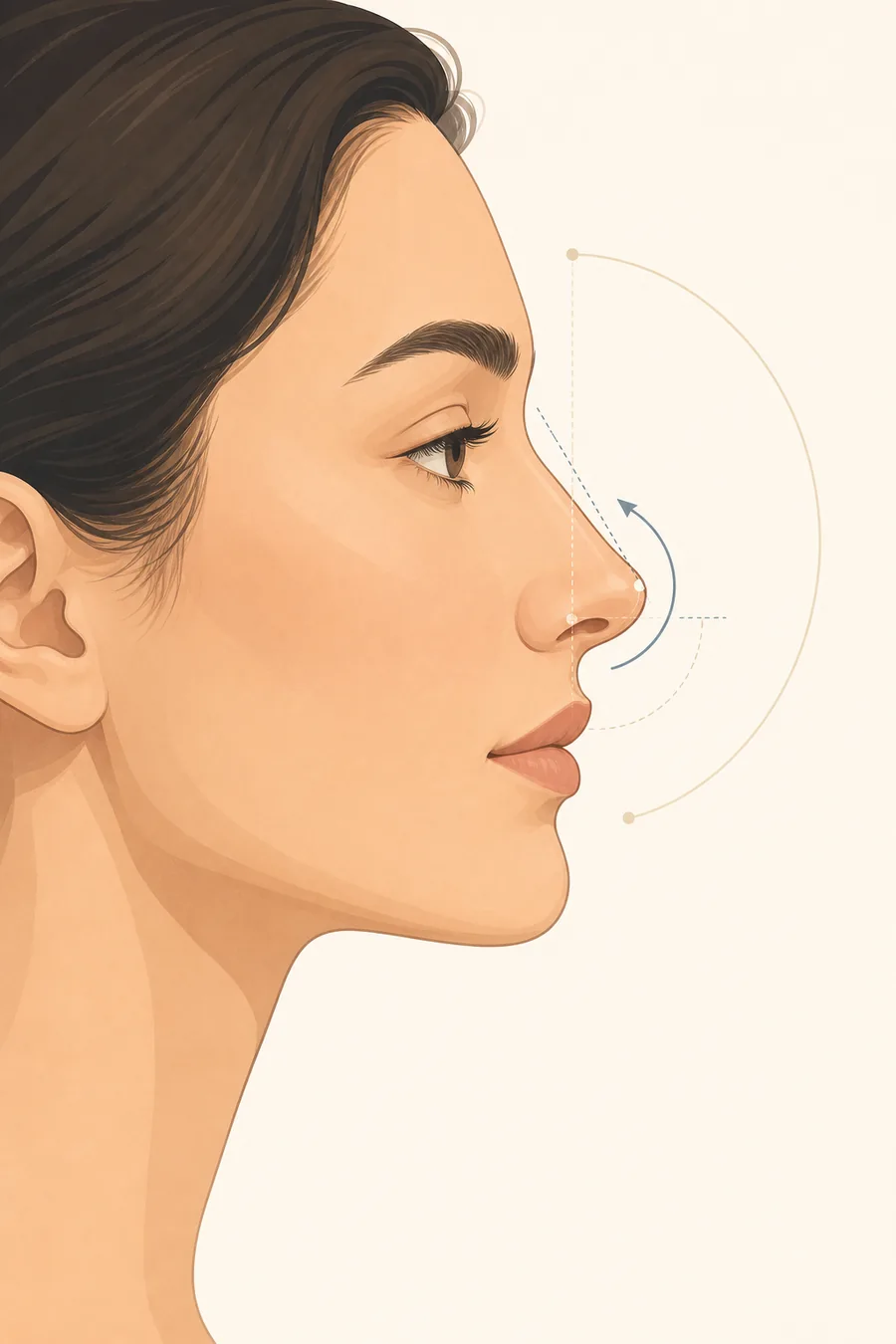
An upturned nose is a nose whose tip rotates upward in side profile. Instead of the tip pointing straight outward or slightly downward, the lower nose turns up enough to make the nostril opening more visible from the front or three-quarter view. Some people also call it a turned-up nose or, in softer beauty language, a celestial nose.
The important distinction is that upturned does not just mean tiny. A person can have a medium-width or even fuller nose with an upturned tip. The shape label describes direction and angle first; width, bridge height, and tip roundness are separate traits.
Main structural clue
The lower tip turns upward in profile and changes the nose-lip angle.
Common mistake
A short-looking bridge in a selfie can mimic an upturned nose even when the real profile is neutral.
If the tip is rounded but not clearly lifted, compare with button nose before using the upturned label.
Upturned Nose vs Button Nose vs Snub Nose
These three labels overlap, but they do not mean exactly the same thing. A button nose is mostly about a small, rounded, soft tip. A snub nose is usually short and upturned, often with visible nostrils. An upturned nose focuses on the direction of the tip; it may be button-like, snub-like, or neither.
The comparison matters because search results often mix the terms together. If your strongest clue is a rounded compact tip, button nose may be the best phrase. If your strongest clue is short profile plus nostril show, snub nose may be more accurate. If the main clue is the upward angle itself, upturned nose is the cleanest label.
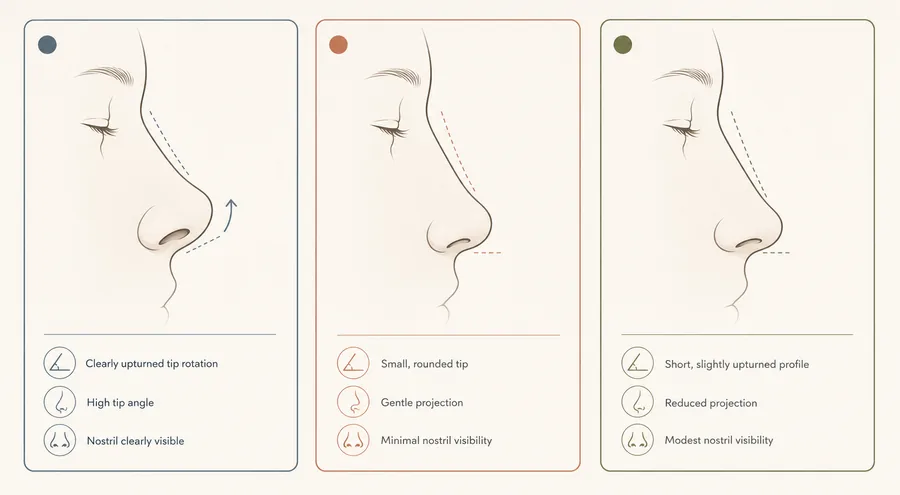
Upturned nose
Defined by tip angle and upward rotation.
Button nose
Defined by a small, rounded, soft-looking tip.
Snub nose
Defined by short profile, lift, and clearer nostril visibility.
Real faces often combine traits. Use the most descriptive label rather than forcing one perfect category.
How to Check an Upturned Nose in Photos
Use two photos: one side profile and one front photo. The side profile shows whether the tip truly turns upward. The front photo shows whether nostrils are visible without head tilt. Keep the camera at eye level and step back far enough to reduce lens distortion.
Lighting also matters. Strong shadow under the tip can exaggerate upward rotation, while heavy contour makeup can hide it. Compare several neutral photos before deciding, especially if your nose only looks upturned in one camera angle.
Side-profile test
Look for the tip angle relative to the upper lip and bridge line.
Front-view test
Check nostril visibility without raising the chin.
Distance test
Retake the photo from farther away if the close selfie makes the center of the face look enlarged.
A fair photo check is more useful than memorizing celebrity examples because camera distance changes nose appearance quickly.
Glasses and Makeup Tips for an Upturned Nose
For glasses, a slightly higher bridge placement or adjustable pads can keep frames from visually shortening the nose. Very low or heavy frames may emphasize the compact, lifted look. Medium-size frames usually balance the tip better than tiny frames that repeat the same scale.
For makeup, avoid making the tip the brightest point if you want the nose to look less lifted in photos. A subtle highlight along the bridge and soft side contour can add visual length, while harsh contour under the tip can make the angle look more dramatic.
Frame fit
Try frames that sit steadily without pressing the tip or sliding onto the cheeks.
Photo makeup
Keep the tip highlight soft and use bridge definition if you want a longer-looking profile.
These are styling options, not corrections. An upturned nose can be balanced, distinctive, and harmonious with the rest of the face.
How to Self-Check Whether Your Nose Is Upturned
Run through this short check before relying on one label.
- Take a side-profile photo at eye level from a normal distance.
- Check whether the tip points upward rather than straight outward or downward.
- Take a front photo and see whether nostrils show without raising your chin.
- Compare with button and snub guides if the nose is also small or rounded.
- Use the AI nose shape detector as a second opinion after you have checked the photos yourself.
The detector is educational and works best with clear, well-lit photos.
Frequently Asked Questions
References and sources
- General anatomy reference for nasal structure, bridge, tip, and nostril terminology. NCBI StatPearls
- Peer-reviewed research on human facial and nasal variation across populations. Nature Communications
Last updated: June 28, 2026