
Contents
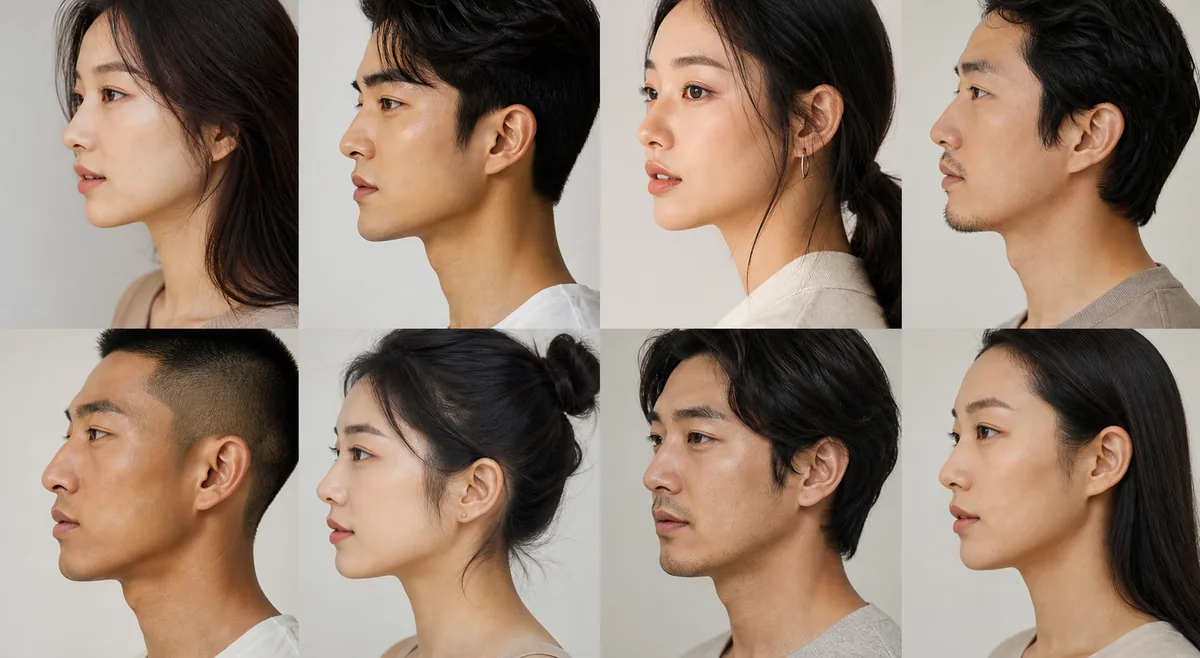
Search results often talk about an “Asian nose” as if it were one shape, but real faces are much more varied. East Asian, Southeast Asian, South Asian, Central Asian, and mixed-heritage faces can show different bridge heights, nostril widths, tip fullness, and side-profile curves. The most useful approach is not to ask whether a nose is Asian, but to break it into visible traits: how high the bridge begins, how much the bridge projects, whether the tip is rounded or upturned, how wide the alar base looks, and whether the profile line is straight, soft, or convex.
Asian Nose Types: Quick Comparison
Use these labels as descriptive shortcuts, not identity categories. A person can match more than one row because bridge height, tip shape, and nostril base are separate features.
| Pattern | Common visual clues | Often confused with | Best next check |
|---|---|---|---|
| Low-bridge Asian nose | Bridge begins near or below the pupil line and looks smoother between the eyes. | Flat bridge, button nose | Check side-profile projection and glasses fit. |
| Flat-bridge Asian nose | Upper bridge has less raised contour from both front and side views. | Low bridge, broad bridge | Compare bridge projection separately from bridge width. |
| Button or soft-tip nose | Tip is compact, rounded, and gentle rather than sharply pointed. | Snub nose, bulbous nose | Check whether the tip is truly upturned. |
| Bulbous or fuller-tip nose | Lower nose looks rounder or wider than the bridge. | Button nose, wide nose | Look at tip width, skin thickness, and nostril base. |
| High-bridge Asian nose | Bridge is clearly projected and begins higher between the eyes. | Straight, Roman, or aquiline nose | Use a side photo to check bridge curve. |
The same person may have a low bridge and a rounded tip, or a high bridge and a wider base. That is why a trait-by-trait check is more accurate than one ethnic label.
Regional Patterns and Why They Vary
East Asian faces are often described in beauty and eyewear guides as having a lower bridge or softer upper-nose projection. That description can be useful for glasses fit, but it should not be treated as a rule. Many East Asian people have medium or high bridges, and mixed ancestry can create combinations that do not fit a simple checklist.
Southeast Asian noses are frequently described with broader bases, rounded tips, or flatter bridges, yet the range is wide across Filipino, Vietnamese, Thai, Indonesian, Malay, and other populations. South Asian faces may show higher bridges, longer profiles, Roman-like curves, or fuller lower noses depending on family background. Central Asian and mixed-heritage faces can overlap with several of these patterns.
Climate and ancestry both influence nasal variation, but they do not determine an individual nose shape. Use regional descriptions as context only. For personal classification, the mirror and side-profile checks below are more reliable than comparing yourself to a generalized ethnic category.
Bridge height
Where the upper bridge begins between the eyes; often the first clue people notice.
Bridge projection
How far the bridge stands away from the face in side view.
Tip shape
Whether the tip looks rounded, compact, full, pointed, neutral, or upturned.
Alar base
The width and flare of the nostril base, which can change the front-view impression.
Avoid ranking these traits. Low bridge, flat bridge, high bridge, and fuller tips are normal variations, not better-or-worse categories.
Low Bridge, Flat Bridge, and Glasses Fit
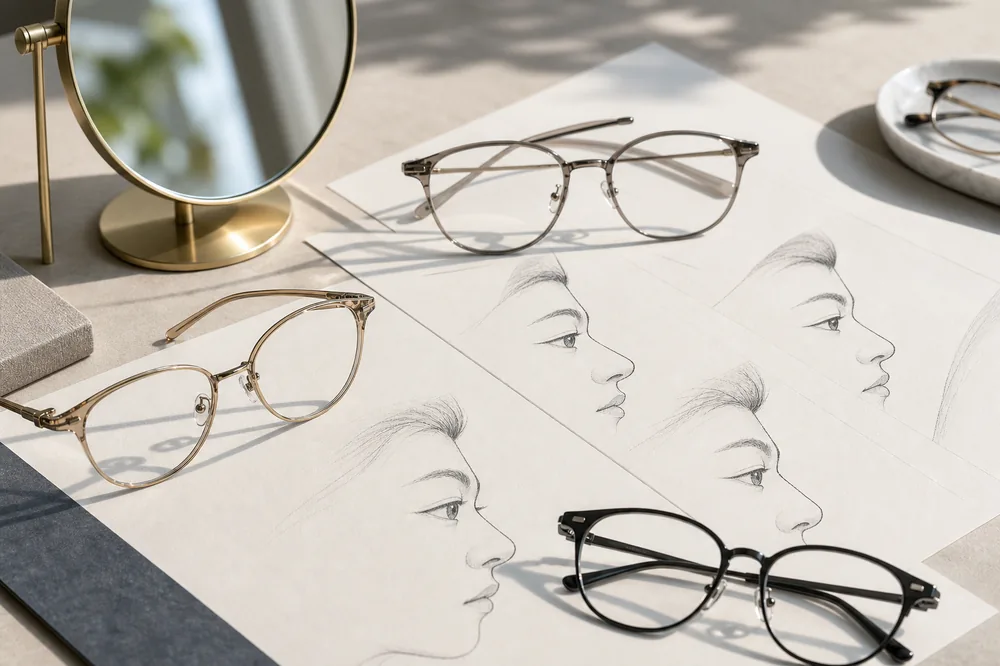
Many searches for Asian nose types are really about low bridge fit. A low bridge usually starts around or below the pupil line. A flat bridge means the upper bridge has less projection. The two often overlap, but they are not identical: a nose can be low but still have a visible side-profile slope, or flatter without being especially wide.
Glasses give practical clues. If frames slide down, touch the cheeks when smiling, or sit too close to the eyelashes, a low-bridge fit, adjustable nose pads, lighter frames, or more pad lift may help. This does not mean the nose is unattractive or abnormal; it only means the frame geometry does not match the bridge support.
If you want a deeper bridge-only explanation, use the site’s nose bridge guide. This page focuses on how bridge type combines with tip and nostril traits to form the broader Asian nose-shape impression.
Low bridge clue
Bridge begins near or below the pupil line in a straight-on mirror view.
Flat bridge clue
Upper nose looks less raised in side profile, even when the base is not especially wide.
Frame clue
Sliding, cheek contact, or lens tilt often points to fit needs rather than a nose-shape problem.
Photo clue
Use eye-level photos; selfies from above can make the bridge look lower than it is.
Bridge fit is practical, not medical. Sudden swelling, pain, injury, or breathing concerns belong with a qualified clinician.
How Asian Traits Map to Nose Shape Labels
Most nose-shape systems use labels such as flat, button, snub, bulbous, straight, Roman, aquiline, and Nubian. Asian noses can appear in several of those categories. A low bridge and broad upper contour may map toward a flat nose. A compact rounded tip may map toward a button nose. A fuller rounded lower nose may map toward a bulbous nose. A short bridge with a visibly upturned tip may map toward a snub nose.
The overlap is where people get confused. Button and snub noses can both look small and youthful, but a snub nose has more upward tip rotation and more front-facing nostril visibility. Button and bulbous noses can both look rounded, but a bulbous nose usually has a wider, fuller tip. Flat and low-bridge noses can overlap, but flat is about projection while low is about starting point.
If your bridge is higher and your profile line is straight, you may be closer to a straight or Greek nose even if you are Asian. If the bridge has a pronounced outward curve, Roman or aquiline traits may be more relevant than the ethnicity-based label.
Flat nose overlap
Low or flatter upper bridge plus broader front-view contour.
Button nose overlap
Small rounded tip with gentle projection and little harsh angle.
Snub nose overlap
Shorter bridge plus a clear upward tip angle and visible nostrils.
Bulbous overlap
Fuller, rounder lower nose where the tip is wider than the bridge.
For the most accurate result, classify bridge height, bridge curve, tip rotation, and nostril base separately before choosing the final label.
Photo Self-Check Steps
Use two photos: one straight-on and one true side profile. Keep the camera at eye level, use natural light, and avoid beauty filters or heavy contouring. A low camera angle can exaggerate nostrils and make a nose look more upturned. A high selfie angle can flatten the bridge and shrink the lower nose.
Start with the bridge. Ask whether it begins above, at, or below the pupil line. Then look at side-profile projection: does the bridge stand clearly away from the face, or does it transition softly from forehead to nose? Next, check the tip: rounded, full, pointed, upturned, or neutral. Finally, look at the nostril base from the front.
If you use an AI nose detector, treat the result as a starting point. AI can help compare visible features, but ethnicity, lighting, expression, camera lens, and makeup can all influence the label. Rechecking with clearer photos often changes borderline results.
Front photo
Best for bridge start, nostril base, and tip width.
Side photo
Best for bridge projection, bridge curve, and tip rotation.
No contour test
Heavy contouring can create a fake bridge or hide a rounded tip.
Repeat check
Use more than one photo before deciding on a borderline type.
Never use nose-shape labels to judge ethnicity or identity. They are appearance descriptors for styling, eyewear, and self-understanding.
Beauty, Contouring, and Rhinoplasty Context
Beauty advice around Asian noses often focuses too narrowly on making the bridge look higher. That can be useful for a specific makeup goal, but it is not the only flattering direction. A softer bridge can suit rounder eyes, fuller cheeks, and gentle facial proportions. A rounded tip can make the face look youthful and approachable. A wider base can balance stronger cheekbones or a broader face shape.
For makeup, keep the contour thin and soft. A low bridge usually looks more natural with a light center highlight and blended side shadows rather than harsh dark stripes. For a fuller tip, shadow only the outer edges and avoid placing a bright highlight on the widest point. For a high or straight bridge, minimal contouring often looks cleaner.
Rhinoplasty and filler searches are common around this topic, but this guide is not medical advice. If you are considering a procedure, discuss your goals, breathing, skin thickness, bridge support, and cultural preferences with a qualified clinician. A good consultation should respect your natural features instead of forcing one universal nose ideal.
Makeup goal
Create subtle dimension without erasing natural bridge softness.
Eyewear goal
Choose frames that sit comfortably instead of chasing a bridge label.
AI goal
Use detection to compare traits, not to rank attractiveness.
Medical goal
Keep procedure decisions separate from casual shape classification.
The best label is the one that helps you choose better makeup, glasses, or reference photos without reducing your face to a stereotype.
Simple Self-Check Workflow
Use this quick process before comparing yourself with example photos.
- Take a front photo and a side-profile photo at eye level in natural light.
- Mark whether the bridge begins above, at, or below the pupil line.
- Separate bridge height from bridge width and side-profile projection.
- Describe the tip as rounded, full, neutral, pointed, or upturned.
- Compare the result with flat, button, snub, bulbous, straight, Roman, and aquiline labels.
- Try the AI detector with a clear photo if you want a second opinion.
This workflow is for appearance and styling only. It does not diagnose ancestry, health, or breathing function.
Asian Nose Types FAQ
References
- The NIH morphology reference explains nasal bridge and nose anatomy landmarks. NIH Elements of Morphology
- A PLOS Genetics study discusses how nasal traits vary with ancestry and climate-related adaptation. PLOS Genetics
- Warby Parker explains practical low-bridge and standard-bridge eyewear fit clues. Warby Parker
Last updated: June 24, 2026