
Table of Contents
Searches for wide nose shape often come from a practical question: is the nose truly broad, or is the camera, lighting, or one feature making it look wider than it is? A useful answer has to separate nasal base width, bridge height, nostril flare, and tip fullness. It also needs respectful language, because wide or broad noses are normal human variation and are common across many populations, not a flaw or a single ethnicity.
Wide Nose Quick Check
Use several visible clues together. One wide-looking nostril photo is not enough for a reliable label.
| Feature | Wide nose clue | What to compare |
|---|---|---|
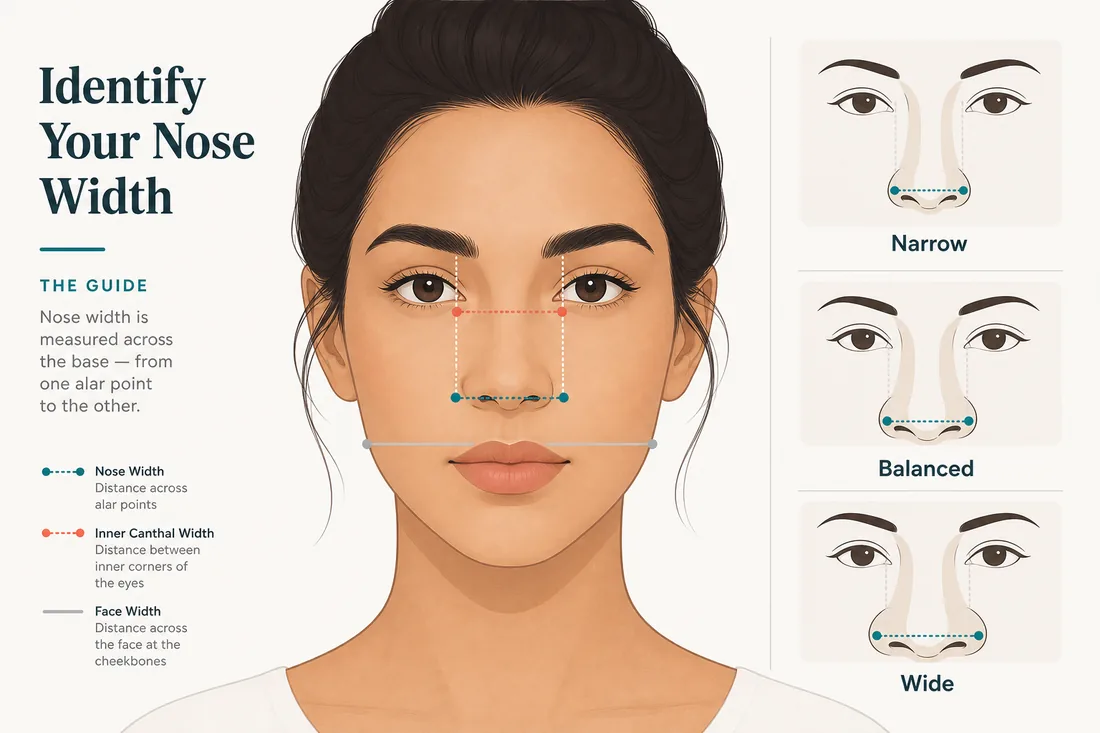
| Nasal base | Base looks broader than the inner eye distance or cheek balance | Compare with the whole face, not just a cropped nose |
| Bridge width | Bridge appears low, broad, or softly defined | A low bridge can make the nose read wider from the front |
| Nostril shape | Nostrils or alar wings spread outward | Check relaxed photos; smiles can widen the base |
| Tip fullness | Rounded or full tip adds lower-nose width | This may be bulbous or wide button overlap |
| Camera effect | Close selfies make the center of the face larger | Use a normal-distance photo before deciding |
If only one clue is present, use a narrower label such as low bridge, flat nose, bulbous tip, or button nose rather than calling the entire nose wide.
What Counts as a Wide Nose?
A wide nose shape is usually a front-view description. The nasal base, nostrils, bridge, or lower nose looks broad relative to the eyes, cheeks, and overall face width. It is not a strict medical measurement and it should not be treated as a beauty score. The same nose may look wide in a close selfie and balanced in a portrait taken from farther away.
The most useful way to read it is by regions. The upper bridge can be broad or low. The middle bridge can be softly defined. The lower base can be wide because the nostrils spread outward. The tip can add width if it is rounded or bulbous. When two or more of these regions point in the same direction, wide nose shape is a reasonable descriptive label.
Front-view label
Wide nose usually describes the face-on impression more than the side profile.
Proportion-based
The label depends on facial balance, eye spacing, cheek width, and camera distance.
A broad nose can still be harmonious, expressive, and balanced. The label describes structure, not attractiveness.
Wide vs Broad, Flat, Button, and Bulbous
Wide and broad are often used almost the same way, but broad tends to sound more anatomical and can refer to a larger base or bridge. A flat nose often combines a low bridge with a wider base, so it may look wide from the front even when the tip is not large. A Nubian nose may have an elongated bridge plus a wider base, while a wide button nose is smaller and rounder but still has noticeable lower-base width.
A bulbous nose is different because the width is concentrated at the tip. If the bridge is normal but the tip looks rounded and full, bulbous is usually more precise than wide. If the nostrils and alar base are the widest part, wide or broad nose is the better everyday phrase.
Wide or broad nose
The base, nostrils, or bridge read wide compared with the face.
Flat nose
A low bridge plus broad base can create a wider front-view impression.
Wide button nose
Small and rounded overall, but with more lower-base width than a classic button nose.
Wide bulbous nose
The tip is the main source of fullness, often more than the bridge or base.
Use the most specific label that explains the visible feature. This avoids forcing every broad-looking nose into one category.
Photo Self-Check
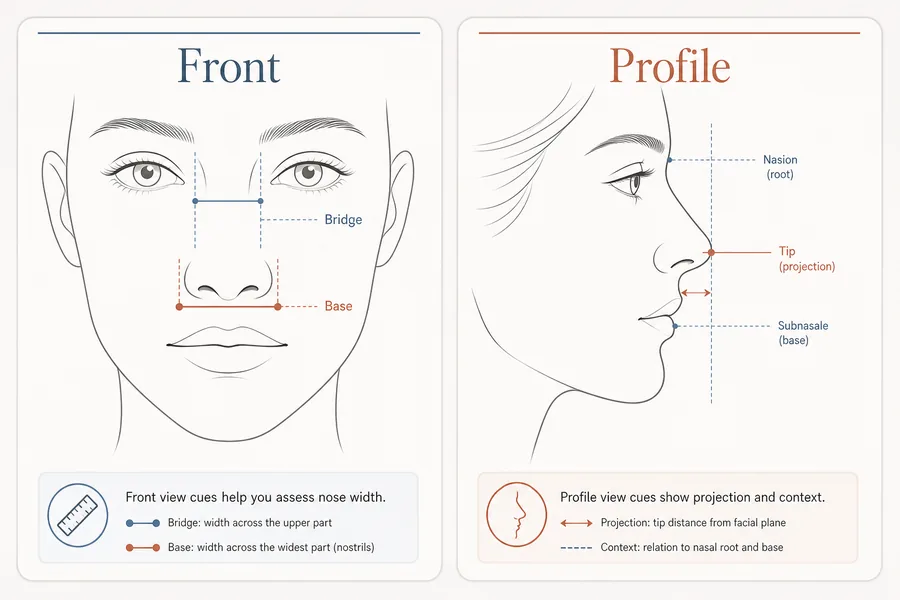
Use a front-facing photo taken from at least an arm's length away, with the camera at eye level and the face relaxed. Very close phone selfies exaggerate the center of the face and can make the nose base look wider. Smiling can also spread the nostrils and cheeks, so compare a neutral expression with a natural smile before deciding.
A side photo helps you separate width from projection. If the bridge is low and the base is broad, the nose may read wide and flat. If the side profile has strong projection but the front base is broad, the shape may be better described as prominent with a wide base. The goal is not to find a perfect label; it is to avoid being misled by one angle.
Best front photo
Natural light, eye-level camera, relaxed face, and enough distance to reduce lens distortion.
Best profile photo
Side view without head tilt so bridge height and projection are easier to judge.
If every close selfie says wide but normal-distance photos do not, trust the normal-distance photos.
Glasses and Makeup Tips
For glasses, fit matters more than trying to hide the nose. A frame with comfortable bridge support or adjustable nose pads can prevent sliding and reduce pressure. If the bridge is low and wide, low-bridge-fit frames often sit better than narrow fixed bridges. Wider frames can also balance the face so the nose is not the only central feature.
For makeup, keep contour soft and vertical if you want more definition in photos. Heavy dark stripes can look obvious and may make the nose look wider by contrast. A subtle center highlight plus soft side shading usually photographs better than harsh correction. These tips are optional style choices, not things a wide nose needs.
Frame fit
Try adjustable pads, low-bridge-fit options, or frames that balance cheek and eye width.
Contour goal
Use soft definition, not strong lines that compete with natural facial proportions.
For breathing, injury, or surgical questions, use this guide only as general information and consult a qualified clinician.
Step-by-Step Check
Run through the same checks each time so the answer is based on structure instead of one unflattering photo.
- Take a front photo from a normal distance with the camera at eye level.
- Compare the nasal base with the inner eye area, cheeks, and total face width.
- Check whether the bridge is low or broad, or whether width is mainly in the nostrils.
- Look at a side photo to separate width from projection, hump, or tip fullness.
- Compare with flat nose, Nubian nose, button nose, and bulbous nose before choosing the final label.
- Use an AI detector as a second opinion, especially if different photos give different impressions.
The detector is a visual aid, not a medical or surgical assessment.
Frequently Asked Questions
References
- Human nose shape variation and climate adaptation research. PLOS Genetics / PubMed Central
- General rhinoplasty overview for medical and surgical boundary context. Cleveland Clinic
Last updated: July 2, 2026