
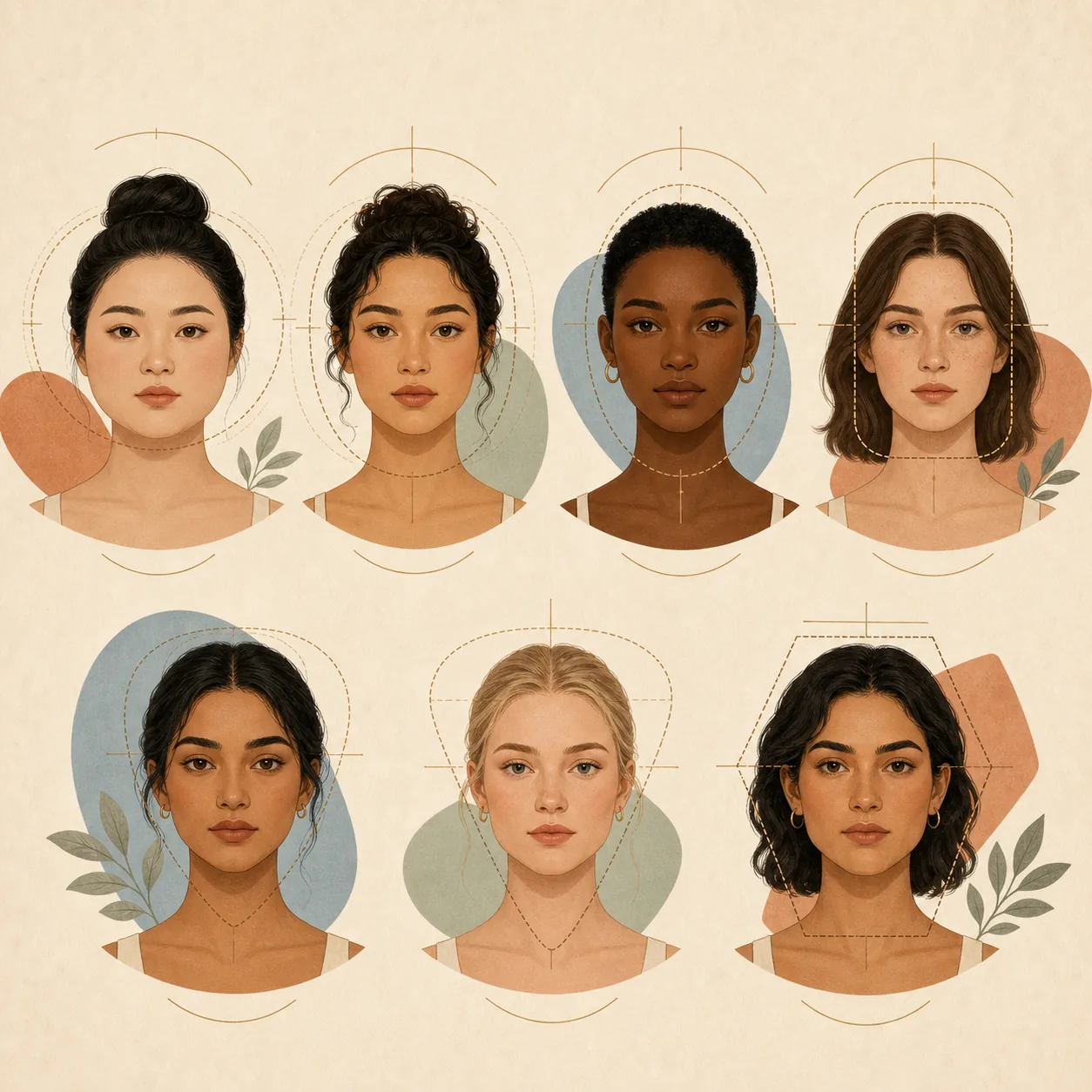
A face shapes men guide starts with proportions, not a celebrity comparison. Measure the same four areas, look at the outline, and use the closest category to guide a haircut, beard, or frame choice.
The phrase men's face shapes describes the relationship between face length, forehead width, cheekbone width, jaw width, and chin direction. Hairline, facial hair, camera distance, and expression change what you see, so one close selfie is weak evidence. A mirror check and a level front-facing photo give you a repeatable view.
This guide covers oval, round, square, oblong, diamond, and heart or triangle patterns used in men's styling advice. The categories are not biological boxes or rankings. A blended result is normal, and hair texture, maintenance, frame fit, and personal taste should make the final decision.
The six face shapes for men at a glance
Most guides group men's faces into six or seven families. Different charts combine heart and triangle or split them into separate rows, but the useful clues stay the same: which area is widest, how long the face appears, and whether the jaw is soft, straight, or sharply angled.
Read the cards below. If two descriptions fit, keep both in mind and use measurements plus a second photo.
Oval
The face is longer than it is wide, the cheekbones are gently prominent, and the forehead is often a little wider than the jaw. The chin tapers without a hard corner.
Main signal: Balanced length with a soft, gradual taper.
Round
Length and width feel close, the cheeks look full, and the jawline curves rather than forming clear corners. The aim is to add structure or visual length if you want it.
Main signal: Similar height and width with soft angles.
Square
The forehead, cheekbones, and jaw are broadly similar in width, with a strong jaw corner and a fairly straight side outline.
Main signal: Angular jaw with width that stays consistent.
Oblong
The face is noticeably longer than it is wide, while the forehead, cheekbones, and jaw stay relatively even. The lower face can be rounded or squared.
Main signal: Length dominates the overall outline.
Diamond
The cheekbones are the widest area, while the forehead and jaw narrow inward. The sides may look angular near the cheekbones.
Main signal: Central width with narrower ends.
Heart or triangle
The upper face or forehead is wider than the jaw in a heart pattern; in a triangle pattern the jaw is the widest zone. Both need a close look at the taper.
Main signal: A clear top-to-bottom width difference.
There is no best face shape for men. The label is useful only when it helps you describe proportions and make a choice you actually like.
How men's face shapes differ in proportion
When two categories look similar, compare the widest area first, then check total length and jaw direction. This prevents a beard, haircut, or camera angle from deciding the label for you.
| Shape | Widest area | Length clue | Jaw or chin clue |
|---|---|---|---|
| Oval | Cheekbones or upper cheeks | Longer than wide | Soft taper and rounded chin |
| Round | Cheeks or evenly distributed | Width and length feel close | Curved jaw with few corners |
| Square | Forehead, cheeks, and jaw stay broad | Often close to equal | Broad, angular, defined jaw |
| Oblong | Widths are fairly even | Clearly longer than wide | Straight sides with rounded or squared chin |
| Diamond | Cheekbones | Often moderately long | Forehead and jaw narrow inward |
| Heart | Forehead or upper face | Can be short or long | Narrow or pointed chin |
| Triangle | Jawline | Varies | Lower face is the broadest zone |
Measurements do not need to match a perfect ratio. Their job is to reveal the dominant pattern. A face can be oval with diamond-like cheekbones, square with an oblong length, or heart-shaped with a softer jaw. Describe the blend when that is more accurate than forcing one word.
How to find your face shape as a man
Use a soft tape measure or a piece of string and ruler. Pull hair away from the outline, keep your head level, and write down one unit system. You are comparing your own measurements, not trying to meet a universal masculine ratio.
Take four readings: forehead width at its broadest point, cheekbone width across the most prominent points, jaw width from jaw angle to jaw angle, and face length from the center of the hairline to the bottom of the chin. If the hairline is difficult to see, use the same visible reference point for every repeat.
- Measure forehead width between the widest points above the eyebrows or at the temples.
- Measure cheekbone width across the upper cheeks, just below the outer eye corners.
- Measure jaw width from one mandibular angle to the other; if you measure one side to the chin, double it.
- Measure face length from the center of the hairline to the lowest point of the chin.
- Compare the widest zone, length-to-width impression, and jaw angle. Repeat with a neutral photo if the result is close.
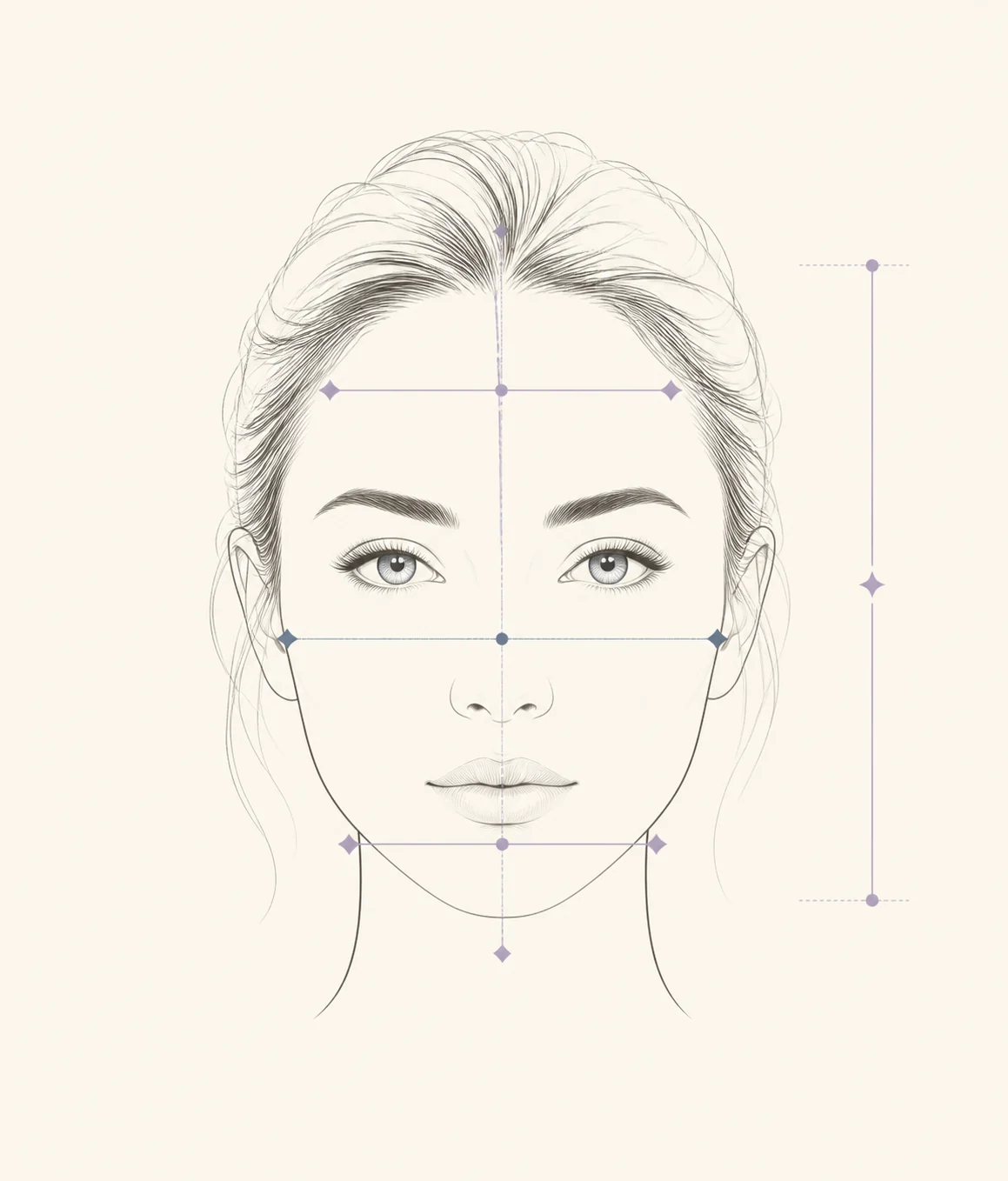
A measurement result is a useful clue, not a diagnosis. If the numbers point one way and the outline another, record a blended description and choose styling ideas that work for both.
Hair, beard, and glasses starting points
The best men's face shape hairstyles create the visual balance you want without hiding your features. Think in terms of height, side width, texture, and where the eye lands. Hair density, curl pattern, workplace needs, and maintenance time matter as much as a chart.
Facial hair is another proportion tool. Keeping the sides close and adding a little length at the chin can make a round outline look longer; a softer lower edge can take the emphasis off a very angular jaw. Frames should be chosen by bridge, lens, and temple fit first, with shape used as a styling direction.
Oval and oblong
Oval faces can handle many cuts, from a textured crop to a side part. For oblong faces, moderate height and some side movement can keep the face from looking longer; avoid adding height and length at the same time if that is not your goal.
Round
A quiff, textured top, or side-swept shape can add vertical direction. Keep side bulk controlled if you want a slimmer outline. A short beard with slightly more length at the chin can add definition without a wide lower edge.
Square
Texture, a soft fringe, or a natural side part can work with a strong jaw. Choose between emphasizing the angles or softening them. Medium-width frames and rounded or mixed geometry can balance a hard jaw, but comfort and fit come first.
Diamond, heart, or triangle
Soft layers, controlled forehead volume, or jaw-level texture can guide attention around a prominent center or a narrow chin. Try moderate frame width and a beard outline that follows growth rather than drawing a harsh new border.
Bring your measurements and a neutral photo to a barber or optician if you want a second opinion. A good recommendation should account for hair texture, frame fit, and the style you are willing to maintain.
Photo limits and common mistakes
Close phone cameras stretch the center of the face and can make the nose or cheekbones look larger. A high camera angle shortens the lower face, while a low angle can exaggerate the jaw. Hair, hats, glasses, expression, and strong side light also interrupt the outline.
Use a front-facing image from a little farther away, at eye level, with soft even light. Compare a second image or mirror view before deciding. Face-shape categories are descriptive style tools; they do not reveal attractiveness, personality, ancestry, health, or gender identity.
- Keep your head level and relax your jaw instead of clenching for the photo.
- Move hair away from the forehead and jaw so the visible outline is not hidden.
- Avoid wide-angle close-ups, dramatic filters, harsh shadows, and heavy contour makeup.
- Use the same landmarks and unit when repeating measurements.
- Let comfort, hair texture, beard growth, and frame fit override a generic chart.
Frequently asked questions
What are the main face shapes for men?
The common groups are oval, round, square, oblong, diamond, heart, and triangle. Some charts combine heart and triangle, so compare the widest area and jaw direction rather than counting categories.
How can I find my face shape without a tape measure?
Pull your hair back, use a level front-facing mirror view, and compare face length, forehead, cheeks, jaw, and chin. A second photo from farther away is more reliable than one close selfie.
Which measurements matter most for men's face shapes?
Record forehead width, cheekbone width, jaw width, and total face length. The widest zone and the relationship between length and width usually narrow the choices; jaw angle and chin shape help confirm the match.
Can a man have two face shapes?
Yes. Mixed descriptions such as oval-diamond or square-oblong are common. Use the dominant proportion as the first label and keep the secondary clue when it changes a haircut, beard, or glasses choice.
What hairstyle is best for my face shape?
There is no single best cut. Start by deciding whether you want more height, side width, softness, or structure, then adjust for hair texture, density, maintenance time, and the proportion you want to emphasize.
Should I use a face shape detector or a calculator?
A detector gives a quick photo-based estimate, while a calculator makes the four-measurement logic visible. Use either as a starting point and compare the result with a level photo, a mirror, and practical fit advice.
Use the label as a practical starting point
For face shapes men, start with the widest area and overall length, then confirm the jaw and chin with four repeatable measurements. Compare the closest two categories instead of forcing a perfect match. When you choose a haircut, beard, or glasses, let comfort, texture, fit, and your own taste decide the final version.