
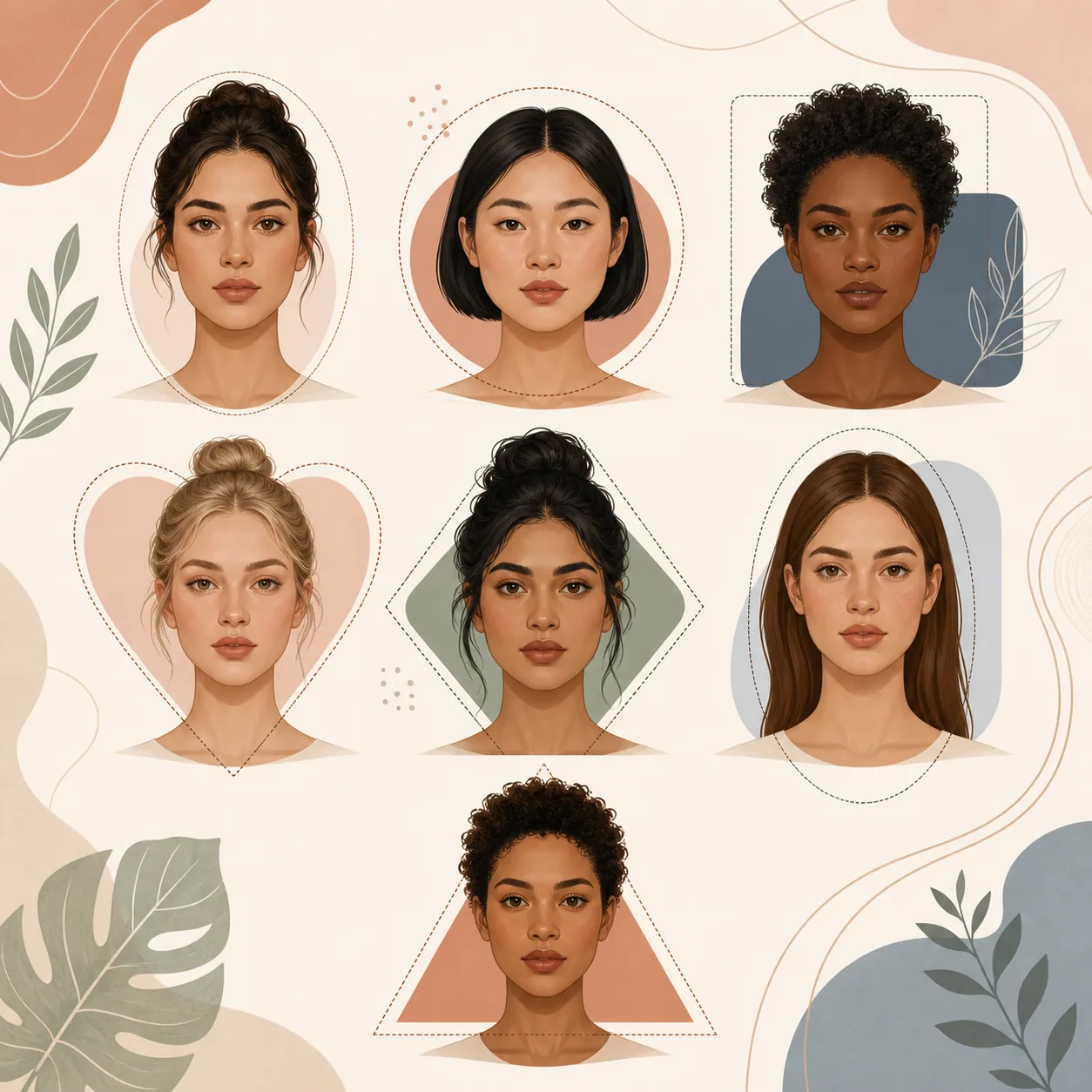
Searching for the types of face shapes usually means you want a useful category, not a perfect verdict. The same face can look longer in one photo, softer in a mirror, or more angular when hair is pulled back.
Most face-shape guides group outlines into seven broad families: oval, round, square, heart, diamond, oblong, and triangle. These names describe visible proportions around the forehead, cheekbones, jawline, chin, and total face length. They are styling and observation tools rather than medical categories.
The most reliable comparison starts with the whole outline. Look at the widest area, compare the length with the width, and then check how the lower face narrows or stays broad. If your result seems to fit two categories, that is normal. A description such as oval-to-oblong or heart with diamond cheekbones can be more accurate than forcing one label.
The 7 common types of face shapes
The categories below are the most useful starting points for a face-shape comparison. Read the outline clues together rather than matching one feature in isolation. Hair, facial hair, makeup, camera distance, and head angle can hide the actual boundaries around the temples and jaw.
There is no requirement for every face to match a drawing exactly. The goal is to notice the dominant pattern that can help you choose a hairstyle, frame, or measurement method—not to make a judgment about attractiveness or identity.
Oval face shape
An oval outline is usually a little longer than it is wide, with cheekbones that are gently wider than the forehead and a jaw that narrows without looking sharp. The chin is typically rounded or softly tapered. Because the transitions are gradual, oval faces can overlap with oblong, round, or heart shapes depending on length and cheekbone width.
Look for: balanced width, soft jaw angles, and a length that is noticeable but not extreme.
Round face shape
A round face often has a similar width and length, with full cheeks and a curved jawline. The forehead, cheekbones, and lower face may appear close in width, while the chin looks short or softly rounded. A wide-angle selfie can make almost any face look rounder, so check a level, slightly farther-away photo before deciding.
Look for: curved sides, a shorter-looking lower face, and few visible corners along the jaw.
Square face shape
A square outline tends to keep a comparable width through the forehead, cheekbones, and jaw. The jaw corners may look clear, and the chin often appears broad or less pointed. Square and round shapes can share similar width, but square faces show more straight edges or angles while round faces transition more continuously.
Look for: a broad lower face and a defined, fairly straight jawline.
Heart face shape
A heart-shaped face is usually wider across the forehead or upper cheekbones and narrows toward a smaller chin. The hairline can appear broad, and the lower face may taper more clearly than an oval face. Some people have a heart-like outline with a softer jaw, while others sit between heart and diamond because the cheekbones are prominent.
Look for: upper-face width, a noticeable taper, and a narrower or pointed chin.
Diamond face shape
A diamond outline is widest around the cheekbones, with a narrower forehead and a narrower jaw or chin. The side outline can look angular, especially around the cheekbone-to-jaw transition. Diamond and heart shapes are easy to confuse; the key difference is that heart shapes usually keep more width in the forehead, while diamond shapes emphasize the cheekbones.
Look for: the cheekbones as the clear widest point and a narrower forehead and jaw.
Oblong face shape
An oblong face is noticeably longer than it is wide, while the forehead, cheekbones, and jaw may remain relatively similar in width. The sides often look more vertical than tapered. Oblong can overlap with oval, but oval usually has more curved narrowing at the jaw and a less pronounced length-to-width difference.
Look for: extra vertical length with sides that stay fairly even from temple to jaw.
Triangle face shape
A triangle face shape is often narrower at the forehead and broader through the jaw. The lower face becomes the visual anchor, and the chin may look broad rather than pointed. Depending on the chin angle, this category can overlap with a square shape or with an inverted heart-like outline viewed under different lighting.
Look for: a jaw that is wider than the upper face and a lower-heavy outline.
The category names are shorthand for proportions. They should help you describe what you see, not turn a normal variation in facial structure into a fixed judgment.
Face-shape comparison table
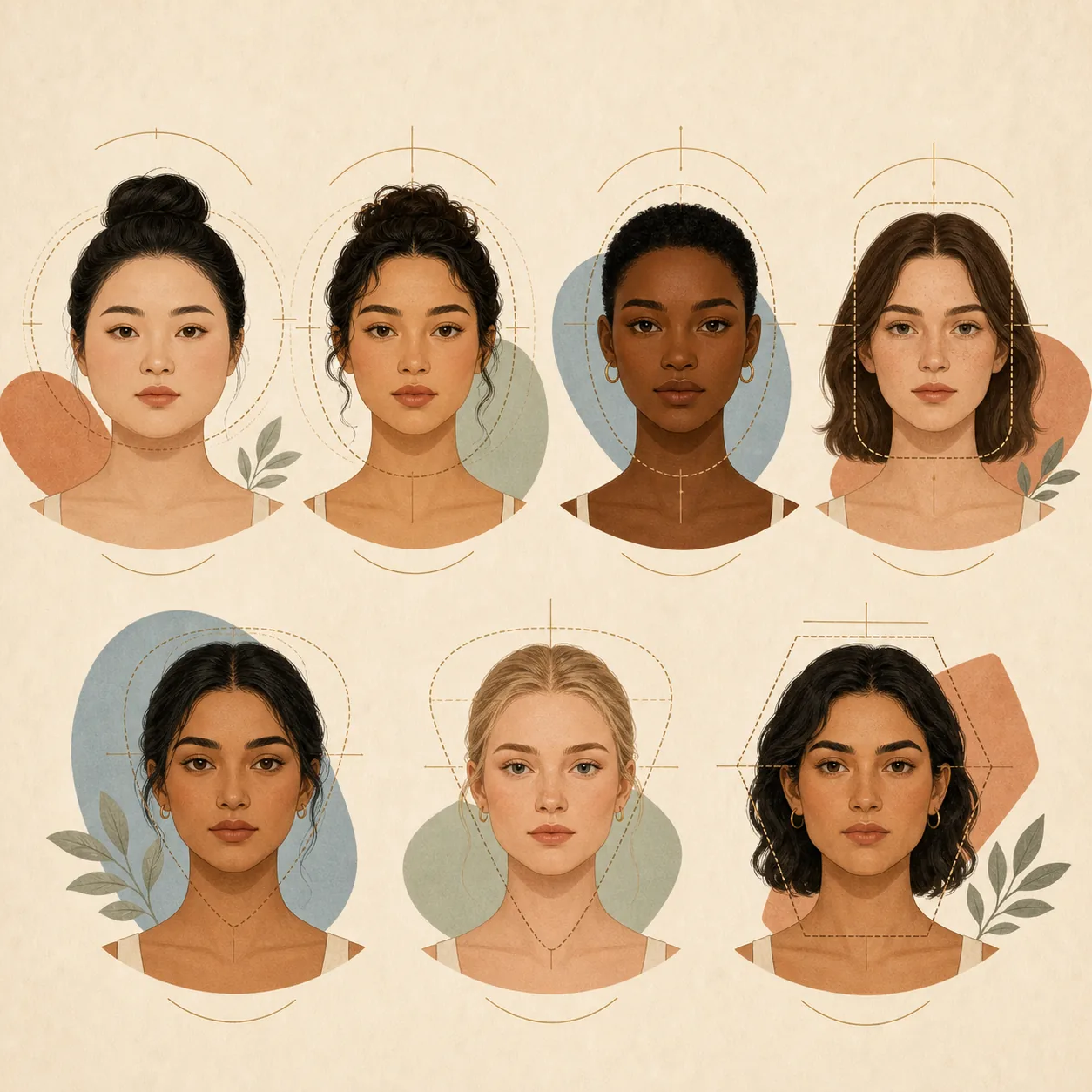
Use this table as a starting filter. The widest area and the shape of the jaw usually tell you more than a single measurement such as face length.
| Face shape | Overall outline | Widest area | Jaw or chin clue | Common mix-up |
|---|---|---|---|---|
| Oval | Longer than wide with soft transitions | Cheekbones | Gently narrows to a rounded chin | Oblong or round |
| Round | Width and length feel similar | Cheeks or cheekbones | Curved jaw with a short-looking chin | Oval |
| Square | Broad with visible corners | Forehead, cheeks, and jaw are similar | Defined, broad jaw | Round or triangle |
| Heart | Upper face broadens and lower face tapers | Forehead or upper cheekbones | Narrow or pointed chin | Diamond |
| Diamond | Angular with a strong central width | Cheekbones | Narrow forehead and jaw | Heart |
| Oblong | Clearly longer with more vertical sides | Width stays fairly even | Jaw does not taper dramatically | Oval |
| Triangle | Lower face is visually heavier | Jaw | Broad or squared lower face | Square |
If two rows seem equally plausible, record both and compare the specific feature that separates them. For example, oval versus oblong is mostly a question of length and side curvature, while heart versus diamond depends more on whether the forehead or cheekbones are widest.
How to identify your face shape
A clear front-facing photo or mirror check is enough for a first estimate. Pull hair away from the temples, keep your head level, relax your expression, and avoid a close wide-angle selfie. The aim is to see the outline from the top of the forehead to the bottom of the chin without adding hairstyle or camera distortion.
If you prefer numbers, compare four measurements: face length, forehead width, cheekbone width, and jawline width. Measure from consistent landmarks and treat the numbers as clues, not a formula that overrides what the outline shows. The jaw angle and chin shape still matter.
Start by asking which area is widest. Then ask whether the face is much longer than wide, whether the jaw is curved or angular, and whether the lower face narrows to a point. This sequence reduces the chance of choosing a label from one memorable feature.
- Use a level, front-facing mirror view or a photo taken from a little farther away than a typical selfie.
- Mark the widest visible points of the forehead, cheekbones, and jaw, then compare them with total face length.
- Check the jawline: is it rounded, straight and broad, sharply tapered, or wider than the forehead?
- Compare the closest two rows in the table instead of scanning all seven categories again.
- Repeat with a second neutral photo if hair, lighting, expression, or camera perspective may have changed the outline.
A blended result is useful information. “Round-to-oval” or “heart with diamond cheekbones” can guide practical choices without pretending that a face belongs to one perfect box.
Why face-shape labels overlap
Face-shape categories are visual conventions. They are not a clinical measurement system, and different guides draw the boundaries in slightly different places. One guide may call a broad, softly angled jaw square; another may describe the same outline as round-to-square.
Photos add another layer of uncertainty. A close lens can widen the center of the face, a high camera angle can shorten the lower face, and hair or facial hair can hide the temples and jaw. Natural left-right asymmetry also means that the two sides will not form a perfect geometric match.
- Do not choose a category from hairstyle, makeup, or facial hair alone.
- Do not treat a single selfie as more reliable than a clear mirror view or a second neutral photo.
- Do not let one ratio override the cheekbone prominence, jaw angle, and chin shape.
- Do not assume mixed results mean that the tool or the guide is broken.
- Do not use a face-shape label as a statement about attractiveness, health, personality, or identity.
Choose a face-shape calculator or detector
Once you understand the seven categories, an online tool can make the comparison faster. Use the face shape calculator when you want to enter forehead, cheekbone, jawline, and face-length measurements and see how the proportions affect the result. It also offers a photo mode for a quick estimate.
Use the face shape detector when you want a fast uploaded-photo starting point. Treat the output as an educational estimate, then compare the explanation with the visual clues in this guide. A tool is most useful when it gives you a repeatable way to check a question—not when it replaces your judgment with an absolute label.
Manual measurement
Best when you want to understand why your forehead, cheekbones, jaw, and face length point toward one category or a blend.
Photo estimate
Best for a quick first pass, provided the photo is clear, level, evenly lit, and shows the full outline.
Two-method check
Best when you are between two types: compare a measurement result with a neutral photo instead of trusting one signal alone.
Our tools are designed for educational face-shape exploration. They do not identify a person and should not be used as medical or psychological assessments.
Frequently asked questions
What are the seven common types of face shapes?
The seven commonly discussed categories are oval, round, square, heart, diamond, oblong, and triangle. They describe broad outline patterns based on face length, forehead width, cheekbone width, jaw width, jaw angle, and chin shape.
Which face shape is the most common?
There is no single agreed global ranking because guides define categories differently and many people have blended proportions. A face can also look different across photos, so it is more useful to identify the dominant outline than to search for one universal most-common type.
Can I have two different face shapes?
Yes. Face shapes are overlapping visual families. You might have the length of an oblong face with the softer jaw of an oval, or the upper-face width of a heart shape with diamond-like cheekbones. A blended label is often the most honest description.
What measurements help identify a face shape?
The usual starting points are total face length, forehead width, cheekbone width, and jawline width. Use consistent landmarks, then check the jaw angle and chin because two faces with similar ratios can still have different outlines.
Can a selfie tell me my face shape?
It can provide a rough estimate, but a close selfie may distort proportions. Use a level head, neutral expression, even light, hair away from the outline, and a little distance from the camera. If the result is surprising, repeat the check with a second photo.
Should I use a face shape calculator or a detector?
Choose the calculator when you want to understand measurements and compare proportions. Choose the detector when you want a fast photo-based starting point. In either case, read the result together with the outline clues and limitations described in this guide.
The useful way to think about face shapes
The seven face-shape types—oval, round, square, heart, diamond, oblong, and triangle—are practical descriptions of proportions, not fixed judgments. Start with the widest area, compare length and width, inspect the jaw and chin, and allow for mixed results. When you want a repeatable check, use the calculator or detector, then interpret the result with the photo conditions and visual clues in mind.