
On this page
People who search for nostril shape are often asking a narrower question than “what type of nose do I have?” They want to understand the openings themselves: whether they look round or elongated, whether they angle forward or downward, and whether one side looks different from the other. That is a useful distinction. The nostril opening is one visible feature, while the full nose type also includes bridge height, tip shape, projection, length, and width.
Nostril shape quick check
Start with these observations, then use the photo steps below. They describe appearance only and do not diagnose breathing or structural problems.
| Feature | What you may notice | What it does not prove |
|---|---|---|
| Opening outline | Round, oval, vertical, teardrop-like, or mixed edges | One outline does not define the whole nose |
| Direction | The opening may face forward, slightly down, or slightly outward | Direction alone does not measure breathing |
| Left-right difference | One nostril can look taller, wider, or more open | Small asymmetry is common and not automatically a problem |
| Nostril base | The base can look narrow, medium, or broad relative to the nose | Width is not a beauty ranking or an ancestry shortcut |
| Photo clue | A farther camera distance gives a more stable comparison | A close wide-angle selfie can exaggerate the center of the face |
Describe the strongest visible feature first. A phrase such as “rounded openings with mild left-right asymmetry” is often more accurate than forcing one rigid nose-type label.
What does nostril shape describe?
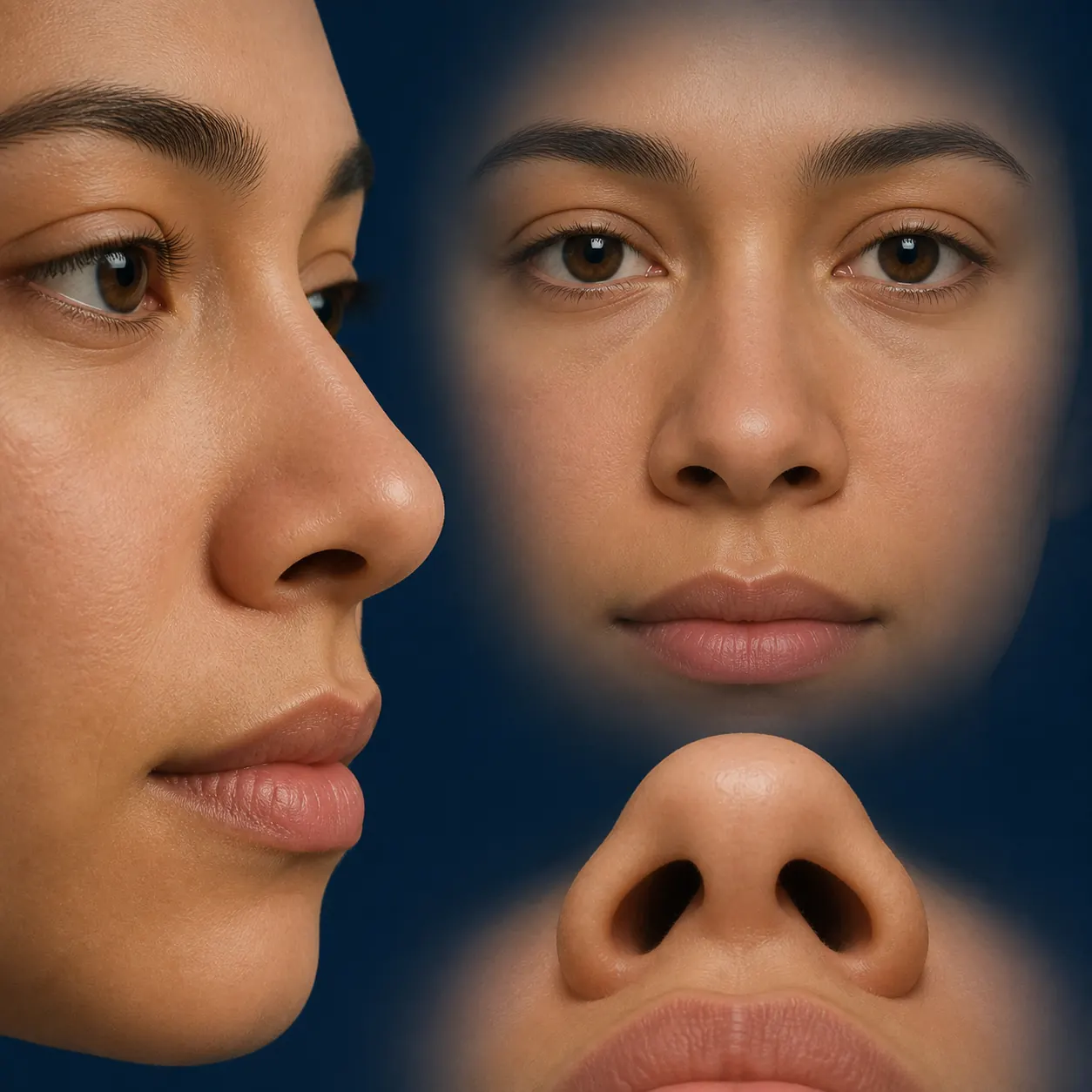
Nostril shape refers to the visible contour of the alar openings at the lower nose. In a photo, that contour is influenced by the rim of the nostril, the soft tissue around it, the angle of the nose, facial expression, and lighting. A front view shows width and how much of each opening is visible. An underside or slightly elevated view shows the opening outline more clearly, but it can also exaggerate the nostrils if the chin is raised.
The term is narrower than nose shape. A person may have a straight or aquiline bridge with rounded nostril openings, or a broad base with oval openings. That is why a useful description separates the opening outline from the bridge, tip, and overall width. It also leaves room for combination traits instead of assuming every face belongs to a single perfect category.
Outline
Look at the inner opening and the outer rim together. The silhouette can be rounded, elongated, tapered, or mixed.
Direction
Notice whether the opening faces mainly forward, slightly downward, or outward in a relaxed pose.
Context
Compare the opening with the nostril base, tip, bridge, and surrounding cheek instead of isolating one dark shape.
Neutral language
Use descriptive words such as narrow, rounded, vertical, or uneven rather than assigning value to the feature.
Nostril shape is an appearance description. It cannot tell you whether airflow is normal, and it should not replace a clinician’s assessment when there is pain, obstruction, or a sudden change.
Common visual patterns in different nostril shapes
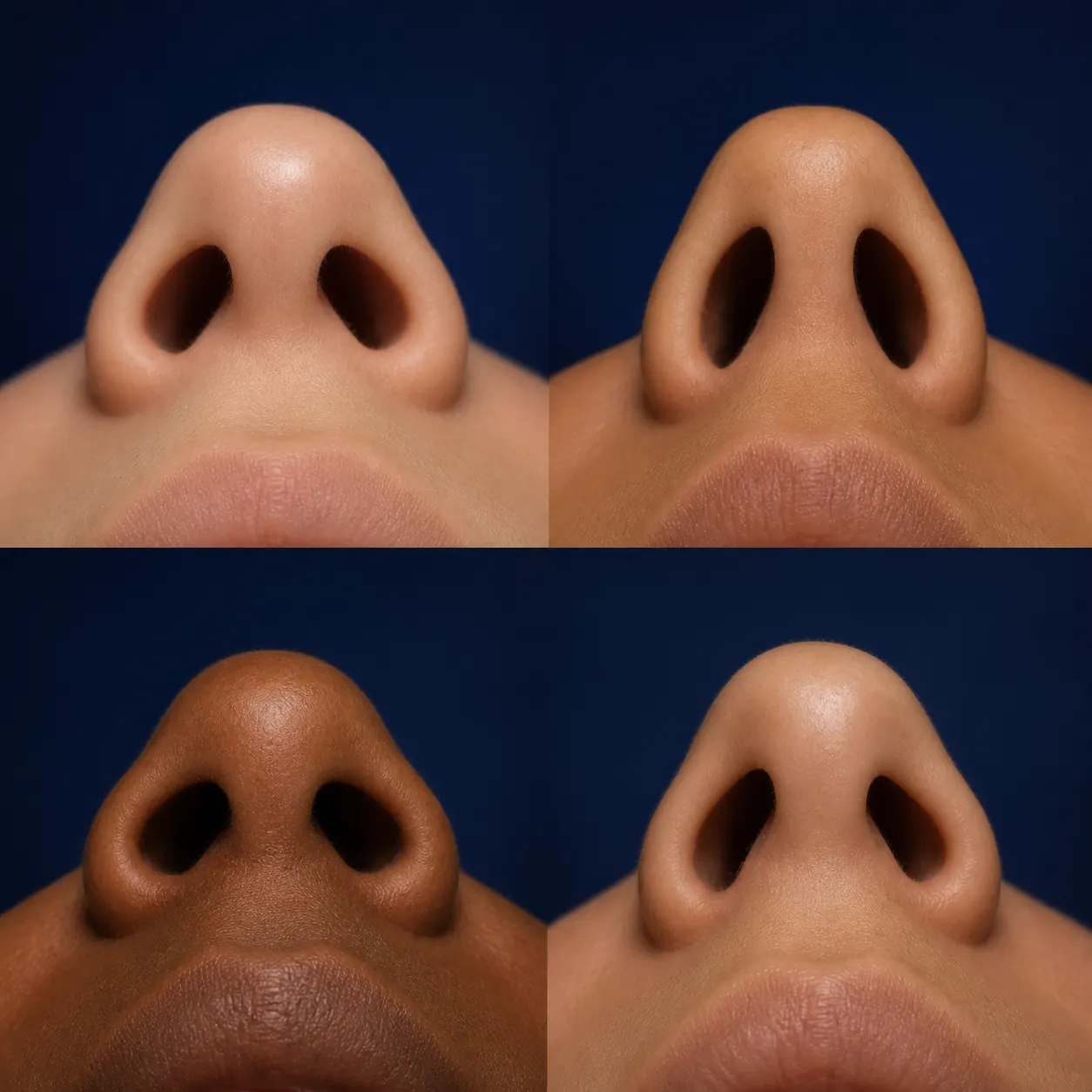
There is no universal checklist that assigns every nostril to one official type. Still, a few visual patterns are useful for explaining what you see. Rounded openings tend to look wider across the middle, oval or vertical openings look longer from top to bottom, and teardrop-like openings often taper toward one end. Many people have a mixed pattern, especially when the two sides are not perfectly symmetrical.
The same nostril can look different when the head tilts, the upper lip moves, or the camera is placed below the face. For that reason, these patterns should be treated as visual shorthand rather than fixed anatomical categories. The goal is better observation: identify the outline, then check whether the same clue survives a second angle.
Rounded
The opening appears wider across the middle, with a softer curve around the rim.
Oval or vertical
The opening looks longer from top to bottom, especially in a neutral underside view.
Teardrop-like
One end appears fuller while the other narrows, creating a tapered outline.
Mixed or asymmetric
The two sides may not match, or one opening may combine a rounded top with a tapered lower edge.
Do not use a visual pattern to infer ethnicity, personality, attractiveness, or health. It is simply a way to describe what a photograph shows.
How to check nostril shape in photos
Take a front photo with the camera at eye level, your face relaxed, and the phone farther away than a typical close selfie. Natural window light is usually easier to read than a bright overhead lamp because it reduces harsh shadows under the tip. Keep the expression neutral and avoid filters or contour makeup while you compare shape.
Next, take a three-quarter photo and, if comfortable, a gently elevated underside view. Do not force your chin upward. The goal is to see the opening without changing the angle of the nose. Compare the two sides at the same distance and crop, because a tilted head can make one nostril appear larger even when the difference is mostly perspective.
Finally, write down only observations that remain visible in more than one image. For example, you might note that both openings look oval, the left side is slightly more open, and the base is medium-width. That record is more reliable than deciding from one dramatic angle or from an image that has been mirrored, stretched, or heavily edited.
Front view
Compare width, rim contour, and the amount of opening visible without lifting the chin.
Three-quarter view
Check whether the same opening outline remains when the face turns slightly.
Underside view
Use a gentle angle only; an exaggerated chin lift can make the nostrils look more open than usual.
Camera distance
Step back and keep the lens near eye level to reduce wide-angle enlargement of the nose.
If your nostril shape seems to change dramatically between photos, trust the farther, level, unfiltered image before trusting the closest selfie.
Natural asymmetry, nose type, and medical boundaries
Left and right nostrils are commonly different in small ways. One opening may be a little taller, the rim may curve differently, or one side may appear more open because of the camera angle. A small difference does not automatically mean that anything is wrong. It is usually more useful to describe the asymmetry than to hide it by forcing both sides into the same label.
Nostril shape also overlaps with other nose traits. A button nose can have rounded openings, a wide nose can have a broad base with oval openings, and an upturned or snub nose can show more of the openings from the front. Those pages answer different questions. This guide owns the opening outline and left-right comparison, while the full nose-shape guide owns whole-nose classification.
A photo guide is not the right tool for a sudden change after an injury, surgery, infection, or swelling, or for persistent trouble breathing. In those situations, use a qualified health professional. The same caution applies if comparing images is making you anxious or pushing you toward a cosmetic decision based on one imperfect photo.
Common variation
Mild differences between sides can be part of normal facial variation.
Whole-nose context
Bridge height, tip rotation, base width, and projection still matter for full nose-type descriptions.
Photo limits
Expression, lighting, mirrored previews, and lens distance can change what looks like asymmetry.
When to ask for help
Sudden structural change, pain, swelling, or ongoing obstruction belongs with a clinician rather than a visual quiz.
The safest conclusion is often specific and modest: describe the visible pattern, list the photo limitations, and avoid turning appearance into a diagnosis or value judgment.
Five-step nostril shape self-check
Use this short sequence before comparing your photo with examples or an AI estimate.
- Take a relaxed front photo at eye level, from farther away than a close selfie.
- Record the opening outline: rounded, oval or vertical, tapered, or mixed.
- Compare left and right without mirroring the image or changing the crop.
- Check a three-quarter or gentle underside view to see whether the same clue remains.
- Add context from bridge, tip, and base width before describing your full nose type.
An AI estimate is for education and curiosity. Use clear, neutral photos and treat the result as a second opinion, not a medical diagnosis.
Nostril shape FAQ
References and sources
- General anatomy reference for the nasal bridge, tip, alar region, and nostril terminology. NCBI StatPearls
- Peer-reviewed research on human facial and nasal variation. Nature Communications
Last updated: August 11, 2026