
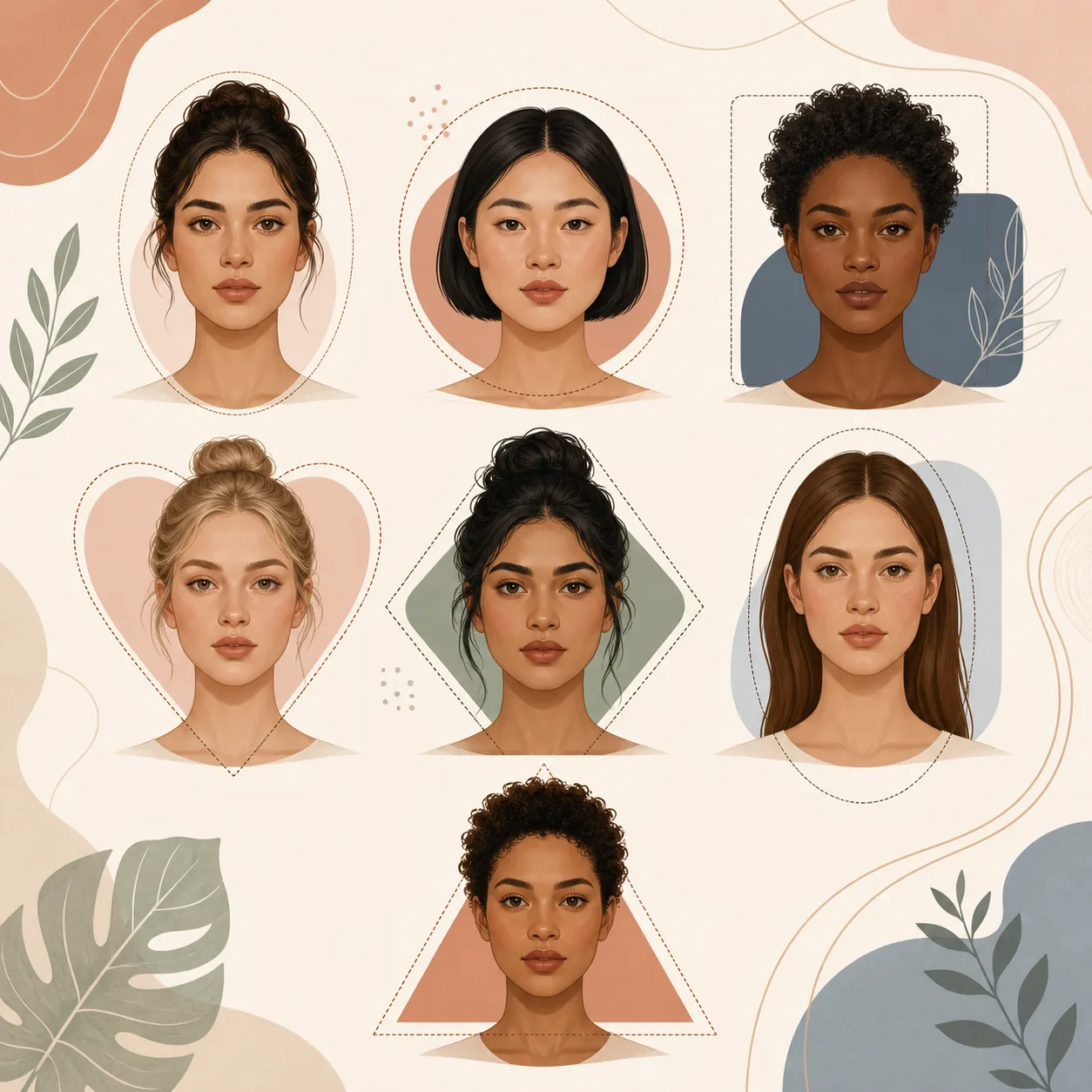
An oblong face shape is a proportion pattern: the face reads noticeably longer than it is wide, while the sides keep a fairly steady width from the forehead through the cheekbones and jaw. It is sometimes called a long face shape, but neither label is a value judgment.
People often search for an oblong face shape hairstyle or glasses guide after noticing a longer chin-to-hairline distance, a narrow-looking side profile, or a face that keeps similar width from top to bottom. Close selfies and wide-angle lenses can exaggerate length, so use more than one view before choosing a label.
This guide explains the visible clues, compares oblong with oval and rectangle patterns, and gives a repeatable self-check. Treat the category as flexible: an oblong face can also have oval softness, a stronger rectangle jaw, or a different impression when hair and camera angle change.
What an oblong face shape looks like
The main clue is length. In a typical oblong outline, the distance from the hairline to the chin is clearly greater than the distance across the cheekbones. Forehead, cheek, and jaw widths may be close, but the jaw does not have to be perfectly straight or square.
Look for the relationship between length and width instead of focusing on one feature. A long oval can look oblong because of its length, while a rectangle can look oblong when a defined jaw is paired with a similarly long outline.
Length is the dominant impression
The face reads taller than it reads wide when you compare the hairline-to-chin distance with the cheekbone width. This is the strongest starting clue.
Look for: a noticeably longer vertical outline than horizontal width.
Side width stays fairly even
The forehead, cheekbones, and jaw can remain within a similar range instead of widening sharply at the cheeks or narrowing quickly at the chin.
Look for: a side outline that keeps a steady rhythm from top to bottom.
The jaw may be soft or defined
Some oblong faces have a rounded jaw like an oval; others have a straighter, more structured jaw. Jaw angle alone does not decide the category.
Look for: whether the lower edge is rounded, gently angled, or clearly broad.
The chin extends the outline
A longer chin or lower-face area can add to the vertical impression, but a pointed chin is not required. Hairline, forehead, and camera angle also affect what you see.
Look for: how the chin contributes to total length rather than its point alone.
Oblong face shape describes proportions, not attractiveness, health, personality, ancestry, or identity. Real faces can be asymmetrical and can sit between oblong, oval, and rectangle descriptions.
Oblong vs. oval, rectangle, and other face shapes
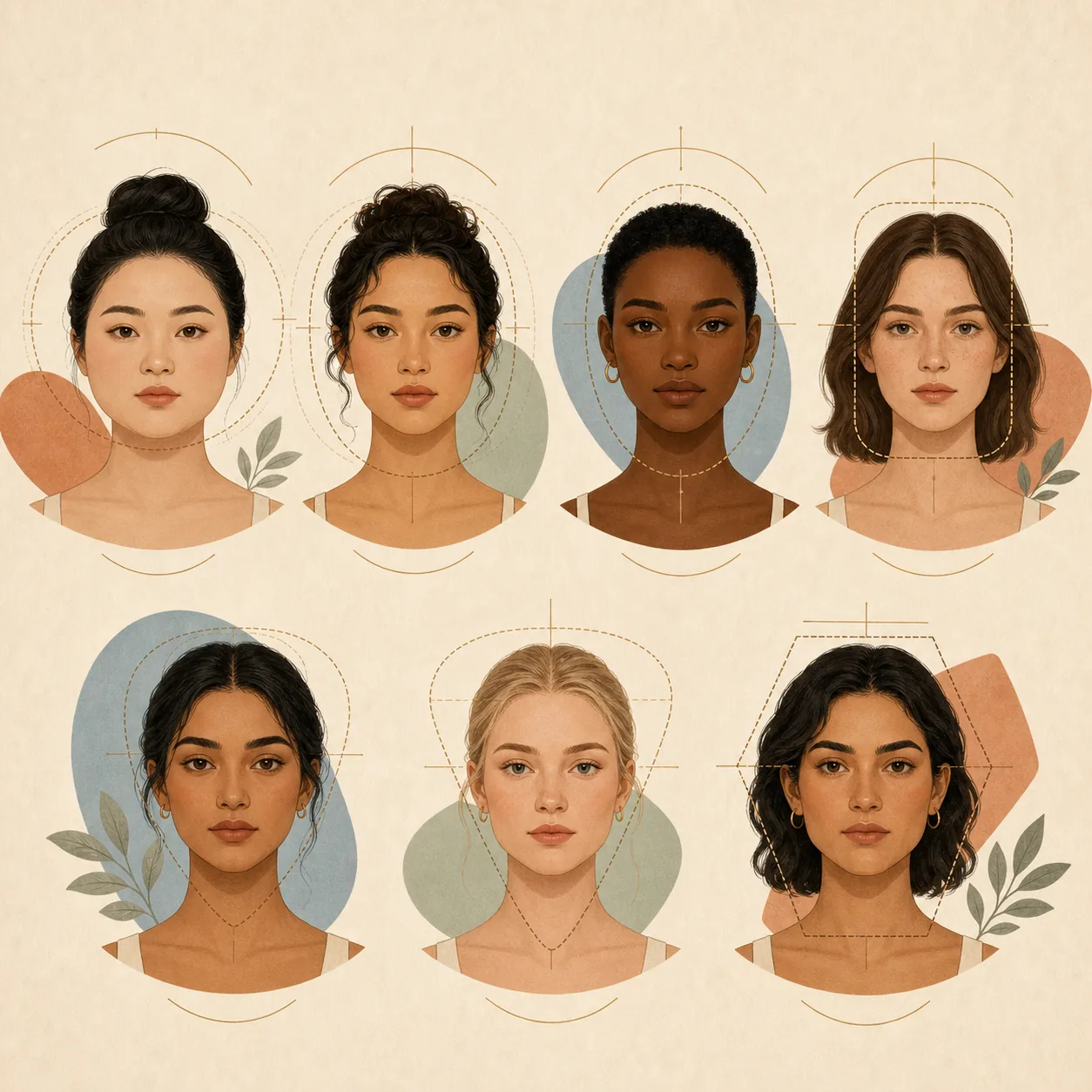
Oblong, oval, and rectangle faces can all look longer than wide. Start with the length-to-width relationship, then check how strongly the forehead, cheekbones, and jaw change as they move down the face.
| Face shape | Main width pattern | Lower-face clue | How it differs from oblong |
|---|---|---|---|
| Oblong | Forehead, cheeks, and jaw are fairly even | Longer outline with a soft or gently defined jaw | Length is the clearest overall signal |
| Oval | Cheekbones are a little wider | Smooth taper to a rounded chin | Transitions are softer and the face often feels more balanced |
| Rectangle | Forehead, cheeks, and jaw stay broad | Straighter, stronger jaw corners | Structure and parallel sides are more obvious |
| Round | Cheeks carry the width | Curved jaw and shorter-looking chin | Length and width are closer together |
| Square | Forehead, cheeks, and jaw are similarly wide | Broad, angular lower edge | The jaw angle is stronger and the face is usually less long |
| Heart | Forehead or upper face is widest | Narrow or pointed chin | The upper face carries more width than the long side outline |
| Diamond | Cheekbones are clearly widest | Jaw and chin narrow inward | Central cheekbone width matters more than even side width |
A longer oval may be best described as oblong with oval softness. A long face with broad jaw corners may sit between oblong and rectangle. Use the comparison to choose useful styling ideas, not to force a single perfect box.
How to tell if you have an oblong face shape
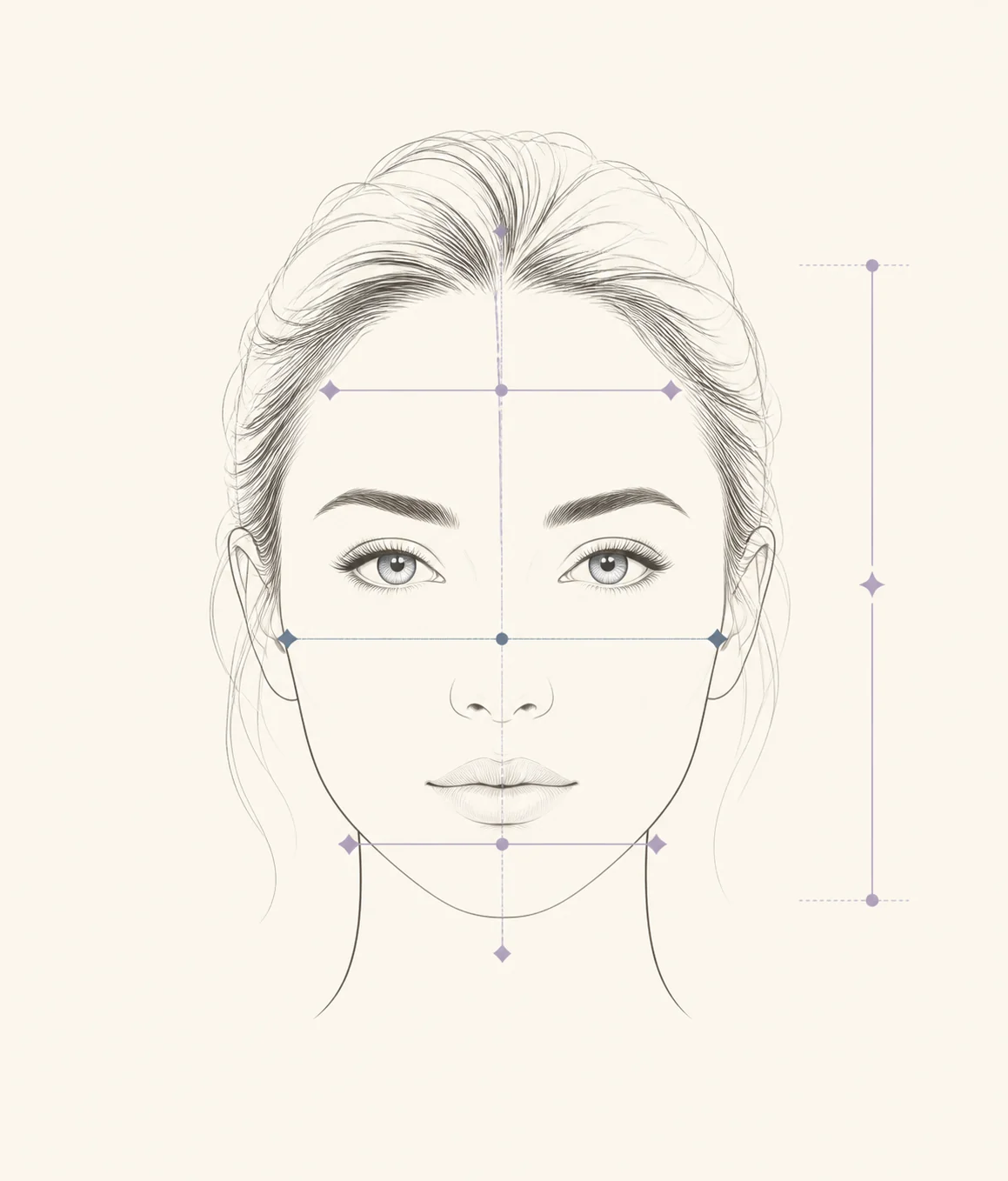
A mirror check and four repeatable measurements are more reliable than one close selfie. Move hair away from the temples, use even light, keep your head level, and relax your expression so the outline is easier to compare.
Record forehead width, cheekbone width, jawline width, and total face length using consistent landmarks. The numbers do not create a medical diagnosis or a universal cutoff; they simply make the length-to-width pattern easier to see.
- Move hair, glasses, and strong contour makeup away from the visible sides of the face.
- Compare total face length with cheekbone width. An oblong pattern usually has a clearly longer vertical measurement.
- Compare forehead, cheekbone, and jaw widths. Similar values suggest an oblong or rectangle direction; a softer cheekbone peak can suggest long oval.
- Inspect the jaw and chin. Note whether the lower edge is rounded, straight, broad, or gently tapered rather than treating one angle as decisive.
- Repeat with a neutral photo or mirror view if the first image was tilted, shadowed, very close, or taken with a wide-angle camera.
A result such as “oblong with oval softness” or “oblong-rectangle” is useful when it matches what you see. Blended language preserves the practical clue without pretending that face-shape borders are biologically exact.
Oblong face shape hairstyles, glasses, and styling ideas
Styling advice works best as a menu of options. Decide whether you want to add width, reduce the visual emphasis on length, or show the long outline clearly, then choose hair and frames that fit your texture, routine, and taste.
Side movement, controlled volume near the temples, and layers that add shape around the cheek or jaw can change the balance. Very tall volume on top may emphasize length, while a blunt or highly structured jawline can emphasize width. These are visual choices, not rules about what anyone should wear.
Hair volume and layers
Side volume, soft fringe, and layers around the cheek or jaw can add horizontal movement. Choose the amount of styling work you can maintain, not only the shape chart suggestion.
Short and long cuts
A textured crop can show the outline, while a medium or longer cut can add movement at the sides. Avoid a tall top only when it makes the length feel stronger than you want.
Glasses
Moderate-to-deeper frames, gentle curves, or a noticeable lower edge can add visual width. Confirm bridge, lens, and temple measurements for real comfort and fit.
Beard and makeup
A softly defined lower edge or horizontal blush and contour placement can shift attention without hiding natural variation. Use gradual shading rather than trying to redraw the face.
If glasses are your main goal, use the face shape detector for glasses for a photo-based starting point, then confirm frame dimensions, bridge fit, and comfort before buying.
Photo and measurement limitations
A close selfie can change the apparent width of the center, a high or low camera angle can alter the chin and forehead, and side lighting can make the jaw look sharper. Hair, glasses, facial hair, and expression can also interrupt the visible outline.
Use a front-facing image from a little farther away, near eye level, with soft light. Compare the silhouette rather than attractiveness. If a detector and manual check disagree, use a second image and look for the feature that stayed consistent.
- Keep your head level and face the camera directly.
- Use a neutral expression and move hair away from the outline.
- Avoid close wide-angle selfies, harsh shadows, and strong contour makeup.
- Use the same landmarks and unit when repeating measurements.
- Treat the label as an educational styling aid, never as a medical, identity, ancestry, or attractiveness assessment.
Frequently asked questions
What is an oblong face shape?
It is usually a face that reads longer than it is wide, with the forehead, cheekbones, and jaw staying within a fairly similar width range. The jaw can be soft or defined.
Is oblong the same as long face shape?
The terms are often used for a similar length-dominant outline. Long face shape is broader everyday wording, while oblong is a face-shape label; the exact boundary varies by guide.
Can an oblong face also be oval?
Yes. A longer oval may have the smooth taper and rounded chin of an oval while still reading as oblong because length is the dominant proportion.
What hairstyle works for an oblong face shape?
Side movement, soft fringe, and layers around the cheek or jaw can add width. Choose based on texture, maintenance, and personal taste; a shape chart is only a starting point.
What glasses suit an oblong face shape?
Moderate-to-deeper frames, gentle curves, or a stronger lower edge can add visual width. Confirm bridge, lens, temple, and comfort measurements before buying.
Should I use a face shape detector or calculator?
Use a detector for a quick photo estimate and a calculator for a repeatable measurement comparison. Read either result with the visible outline and its limitations.
The practical way to use an oblong face shape label
Start with the relationship between length and width. An oblong face shape usually reads longer than wide, with fairly even forehead, cheekbone, and jaw widths. Confirm the impression with a level photo or repeatable measurements, compare oval and rectangle patterns, and allow for blends. For hairstyles or glasses, use the label as a flexible starting point and let comfort, texture, fit, and personal style make the final decision.