

On this page
Straight nose is an appearance label for a bridge line that looks mostly even in profile. It does not require a tall bridge, a narrow base, a pointed tip, or perfect symmetry. The same straight bridge can sit on a short or long nose and end in a rounded, neutral, upturned, or slightly downturned tip. Because close selfies can bend proportions, identify the bridge line from several neutral photos rather than one camera angle.
Straight nose characteristics at a glance
The defining clue is the bridge contour in side profile. Check other dimensions separately before choosing a label.
| Feature | Typical appearance | Do not confuse it with |
|---|---|---|
| Bridge line | Mostly even from the upper bridge toward the tip | Bridge height or overall nose size |
| Side profile | No strong convex hump and no obvious concave dip | A small normal irregularity or lighting shadow |
| Front view | May look narrow, medium, or broad | Front-view symmetry alone |
| Tip | Can be pointed, rounded, neutral, upturned, or downturned | Tip rotation as the bridge category |
| Length and projection | Can be short, medium, or long | Greek or Roman labels based on length alone |
A useful description separates bridge contour, bridge height, base width, projection, and tip shape instead of forcing the whole nose into one word.
What is a straight nose shape?
A straight nose shape usually means the visible dorsal line—the line running down the bridge in profile—appears relatively linear. It lacks the pronounced outward curve associated with a strongly convex, Roman, aquiline, or hooked profile and the noticeable inward scoop associated with a concave profile. Small changes in cartilage, skin thickness, or lighting can still create gentle irregularities without changing the overall straight impression.
Everyday nose labels overlap. A Greek nose is often described as having a high, straight bridge with a smooth forehead-to-nose transition, but not every straight nose has that high-rooted look. A narrow nose describes width, while a straight nose describes contour. Someone can therefore have a straight wide bridge, a straight narrow bridge, or a straight bridge with a rounded tip.
Straight nose bridge vs high, low, narrow, or long nose
Straightness answers one question: does the bridge line run evenly, curve outward, or dip inward? Bridge height answers how prominently the upper nose stands from the face. Width answers the horizontal span of the bridge, base, or nostrils. Length describes the distance from the root area to the tip, while projection describes how far the nose extends forward.
These measurements combine in many ways. A low bridge may still be straight. A high bridge may be straight or convex. A long nose can end with a neutral or downturned tip, and a narrow nose can have a straight, concave, or curved profile. Separating the dimensions makes self-identification more accurate and reduces stereotypes about what a label is supposed to look like.
Straight nose vs Greek, Roman, aquiline, convex, and concave profiles
A Greek nose is usually a straight-profile subtype with a relatively high bridge and a smooth root transition. Roman and aquiline noses are usually more convex, with an outward curve or dorsal prominence. Hooked is a stronger everyday term for a curved bridge that may also turn downward near the tip. A concave nose has the opposite contour: the bridge dips inward before reaching the tip.
The labels are descriptive rather than diagnostic, and mild profiles often sit between categories. If your bridge is mostly straight but has a tiny bump, it may still read as straight in ordinary photos. If the curve is the dominant feature from several angles, convex or Roman may be the better description. The general nose-types guide and the Roman-vs-Greek comparison provide broader context.
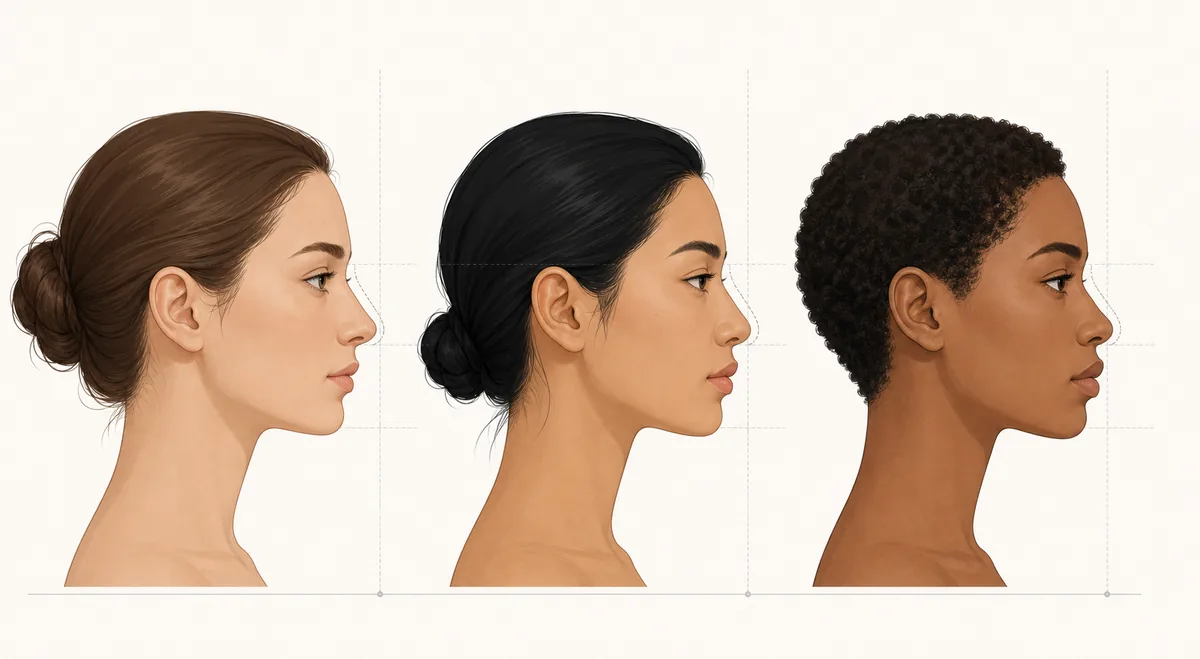
Straight
The bridge follows a mostly even line; height and width can still vary.
Greek
Usually combines a straight line with a higher bridge and smooth root transition.
Roman or aquiline
The bridge shows a clearer outward curve or dorsal prominence.
Concave
The bridge dips inward before the tip, sometimes creating a scooped profile.
A straight bridge can end in a rounded, upturned, or downturned tip
The tip does not have to continue the bridge line at exactly the same angle. A straight bridge with a rounded compact tip may overlap visually with button-nose traits. A straight bridge with slight upward rotation can resemble an upturned or snub nose, while a longer bridge with a downward tip can look more prominent without becoming Roman or aquiline unless the bridge itself is convex.
Nostril width also varies independently. A person can have a thin straight bridge with wider nostrils, or a broad straight bridge with a narrow-looking tip. In descriptions, phrases such as 'straight bridge with rounded tip' or 'straight bridge with a broad base' are usually more precise than claiming one rigid type.
How to identify a straight nose in front and side photos
Start with a true side view because bridge contour is hardest to judge from the front. Use even daylight, keep the camera level with the middle of the face, and stand at least an arm's length from the lens. Relax your expression and avoid portrait-mode reshaping, beauty filters, wide-angle close-ups, and screenshots from video calls.
Then compare a front and three-quarter view. The front view helps you assess width and symmetry, while the three-quarter view shows how bridge height and tip projection connect. Repeat the photos on another day and compare a mirror view. A close phone selfie can enlarge the tip, narrow the sides of the face, and make a straight bridge appear more curved than it is.
Is a straight nose attractive, inherited, or a health sign?
Attractiveness is subjective and changes across people, cultures, eras, styling choices, and camera presentation. A straight bridge is often featured in beauty discussions, but there is no single ideal nose and a bridge label cannot measure facial harmony. Proportion, expression, lighting, and the viewer's preferences affect perception more than one isolated contour.
Nose features are influenced by many inherited and developmental factors, but one straight bridge cannot reliably identify ancestry or a geographic origin. A lifelong stable shape is usually normal variation. This guide is not a medical assessment: seek qualified care for a new bend after injury, sudden collapse, increasing asymmetry, pain, repeated bleeding, or breathing difficulty rather than relying on an appearance label.
Do not use a nose-shape category as a diagnosis, ancestry test, personality reading, or beauty ranking.
Five-step straight nose self-check
Use repeatable photos and separate the bridge contour from the other dimensions.
- Remove filters and take a relaxed true side photo in even daylight.
- Keep the camera at face height and at least an arm's length away.
- Trace the bridge visually from the root area toward the tip: mostly even, outward-curving, or inward-dipping?
- Judge bridge height, base width, length, and tip direction as separate traits.
- Compare front, three-quarter, and side views from more than one photo session before choosing a label.
The detector provides an appearance-based estimate, not a diagnosis, ancestry result, or attractiveness score.
Frequently asked questions
Anatomy and safety context
- A clinical overview of the external nose, nasal bones, cartilage, and airway structures. Cleveland Clinic: Nose anatomy
- Medical guidance on nasal injury symptoms and when breathing problems need assessment. MedlinePlus: Nose injury
Last updated: July 30, 2026