
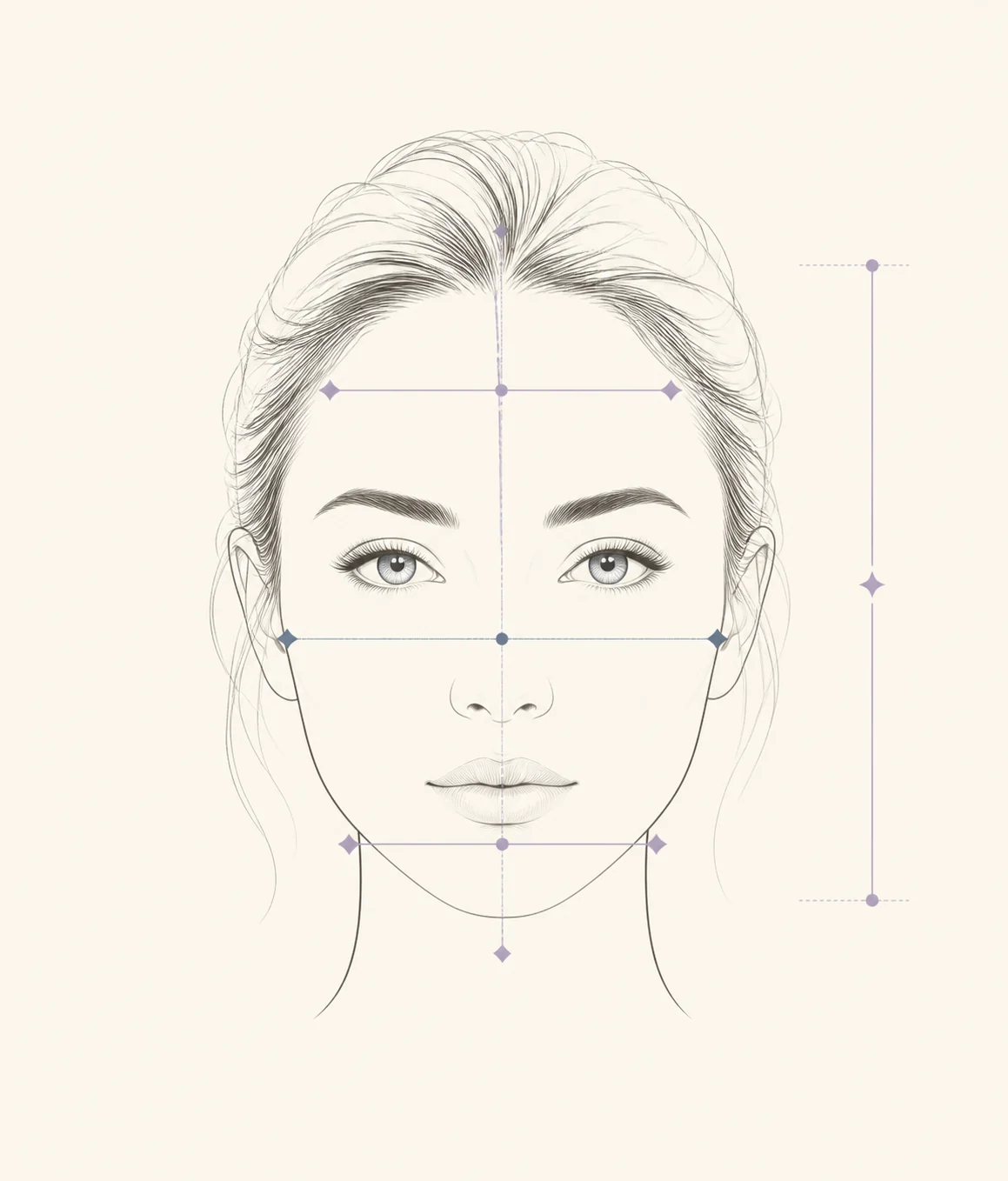
A face proportions guide is useful when you want a clear way to compare features rather than a single score.
Face proportions describe relationships between visible landmarks such as the hairline, brow line, nose base, chin, eyes, nose width, mouth, and jaw. A mirror, a neutral photo, and a consistent ruler can show a pattern, but every measurement has a margin of error.
This page explains the facial thirds rule, the horizontal fifths idea, and a simple home workflow. It is written for styling, portrait study, and general curiosity; it is not a medical assessment or a ranking of faces.
What face proportions mean
A facial thirds test compares the distance from the hairline to the brow line, the brow line to the base of the nose, and the base of the nose to the bottom of the chin. The result is usually shown as three measurements, three percentages, or a ratio such as 6.4 : 6.2 : 6.5. This makes the calculation easier to inspect than a label produced by a hidden model.
The landmarks are visual reference points, not perfectly fixed borders. Hairlines can be difficult to see, brows move with expression, and the base of the nose can be estimated differently in a front view. That is why this page uses a range-based interpretation instead of declaring a normal or abnormal face. A small difference is often less important than using the same method every time.
Use the tool when you want a quick face proportions check, a starting point for a facial analysis discussion, or a way to understand why two photos can look different. It can also help you prepare questions for a qualified professional, but it cannot diagnose a condition, predict a treatment result, or replace an in-person assessment.
Think of face proportions as a map for comparison. A map can help you choose a next step without claiming that one route is more valuable than another.
Facial thirds
The facial thirds idea is a simple way to organize vertical face proportions into three comparable sections.
Use the landmark descriptions as a repeatable method rather than trying to measure from different photos or angles.
Upper third
Measure vertically from the center of the visible hairline to the level of the brows. If the hairline is not visible, note that the result is approximate and avoid comparing it with a measurement that used a different starting point.
Middle third
Measure from the brow line to the base of the nose. Keep the ruler centered and use the same brow reference on both sides. A raised brow or a tilted head can make this section look longer than it is.
Lower third
Measure from the base of the nose to the lowest point of the chin. A relaxed mouth is easier to repeat than a smile, pout, or clenched jaw because expression can change the visible endpoint.
| Largest-to-smallest spread | Tool label | What it means |
|---|---|---|
| 0–4.5 points | Close proportions | The three percentages are relatively near one another in the entered example. Recheck the landmarks if you need a more reliable comparison. |
| 4.6–9 points | Moderate difference | One section is more noticeable in the ratio. This can be a useful observation, but it should still be read with photo angle and measurement error in mind. |
| Over 9 points | More varied proportions | The largest and smallest sections are farther apart. Confirm that each measurement used the same posture, landmark definition, and unit before drawing conclusions. |
Horizontal fifths and width relationships
Horizontal face proportions are often explained with a five-part guide: the distance from one ear to the eye, the eye width, the space between the eyes, the other eye width, and the distance to the other ear. A related reference compares the distance between the inner eye corners with nose width. These are landmarks for observation, not rules that every face must satisfy.
Width readings are sensitive to expression, lens perspective, and where the cheek or nose edge is marked. Use them to ask a useful question—where does the face look widest, and how do the eyes, nose, and mouth sit inside that width?—instead of trying to reach a target ratio.
Eye spacing
Compare the space between the inner corners of the eyes with one eye width. Small differences are common and may be hard to judge in a smiling or squinting photo.
Nose width
Mark the widest points of the nasal wings in a relaxed front view. Camera distance can make the center of the face look wider than it is.
Mouth and nose
A mouth-to-nose comparison can describe placement, but it should not be turned into a score. Lip shape and expression change the visible edges.
Outer width
Look from the ear area toward the eyes and cheekbones to understand the whole frame. Hair and shadows can hide the true outline.
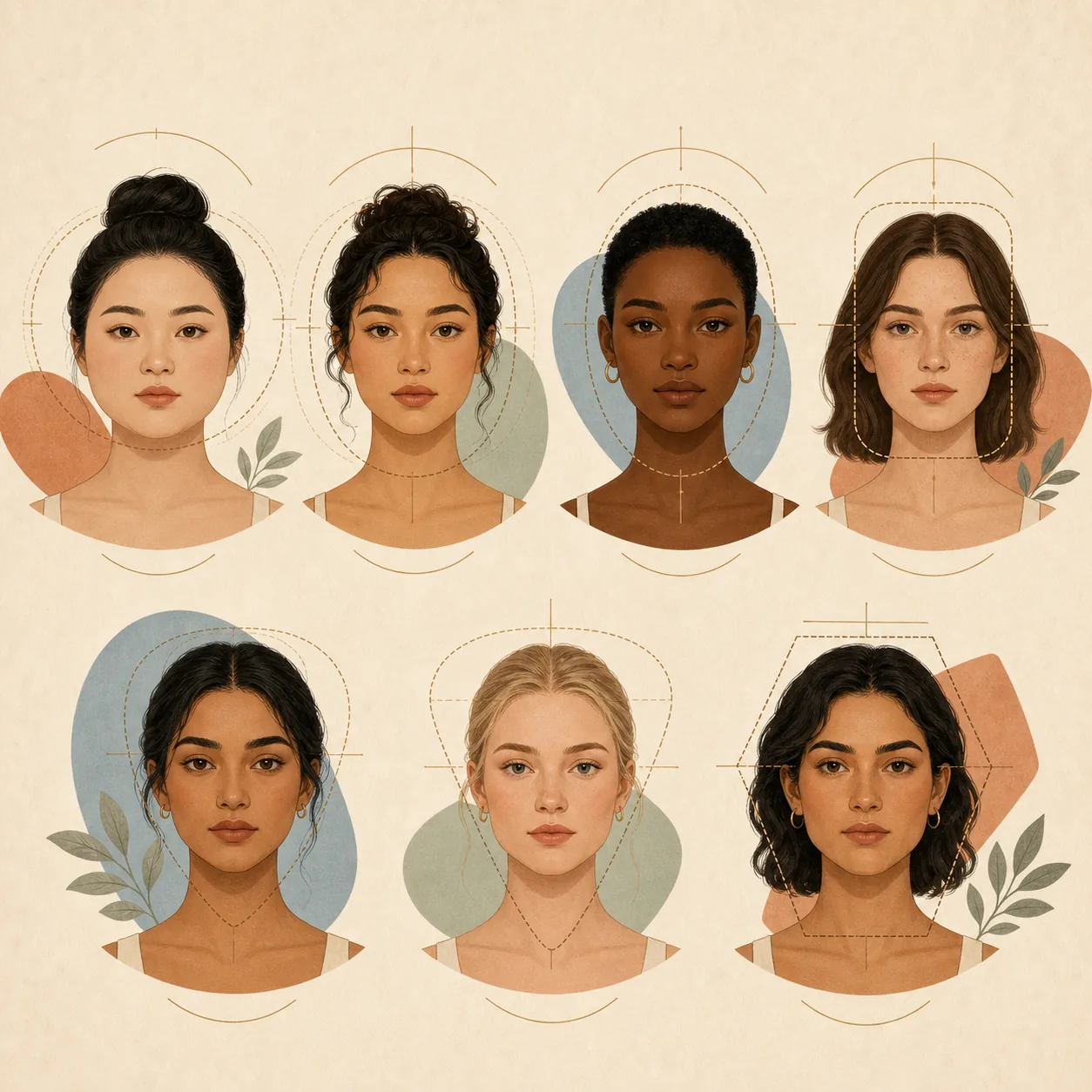
Classic canons are useful reference points, but published studies show that real populations vary. Use a range and your own repeated evidence, not an idealized template.
How to measure face proportions at home
Use one straight-on photo or a mirror, pull hair away from the landmarks, and keep your head level. Write down the method before measuring so a second check can be compared fairly. A soft tape, string with a ruler, or a transparent ruler can work; the unit is less important than using it consistently.
Mark the center of the hairline, brow line, base of the nose, bottom of the chin, cheekbone points, jaw angles, eye corners, and the widest nose points. Do not press a tool into the skin or stretch your expression to make a line fit.
- Choose a relaxed, front-facing image taken from a little farther away than a close selfie.
- Mark the hairline, brow line, nose base, and chin, then record the three vertical gaps in one unit.
- Mark cheekbone, forehead, and jaw widths and note which area is widest.
- Repeat once with the same landmark definitions; if the readings move, keep the range and explain why.
- Compare the pattern with the interpretation table or open the Facial Thirds Test for a transparent calculation.
Keep the camera level
Place the lens near eye level, keep your face centered, and avoid a close selfie. Wide-angle distortion can change the apparent distance between the nose and chin.
Relax your expression
Use a neutral mouth and relaxed brows. Smiling, raising the brows, or pushing the chin forward changes the visible landmarks and makes repeat measurements harder.
Repeat before comparing
Take two readings from the same setup and use a consistent method. If they differ noticeably, report the range rather than choosing the more flattering result.
The goal is a repeatable observation, not a perfect decimal. If a second reading differs, report the difference instead of hiding it.
How to interpret a face proportions result
Equal thirds are a familiar starting point, but equal is not a requirement for a healthy or attractive face. The Cutis review and population studies cited below describe variation by sample and method. Use the table as a reading aid, not as a pass-or-fail classification.
A result is more useful when it answers a practical question: does the lower face appear longer in this photo, are the cheekbones the widest area, or did a close camera exaggerate the nose and center? Those observations can guide a haircut, frame choice, or a better second photo.
A close example
Values of 6.4, 6.2, and 6.5 create percentages near one third each. The result is close, with only a small spread between the sections.
A middle difference
Values of 5.8, 6.8, and 7.4 make the lower section longer and the upper section shorter. Repeating the measurement can show whether that pattern is stable.
A setup warning
A very short upper value can happen when the visible hairline is hidden by hair or the photo is tilted. Check the landmark before treating the result as a personal trait.
If the pattern feels surprising, check the image setup before assigning a strong meaning to the number.
Limits, diversity, and responsible language
Face proportions are influenced by age, expression, hairline shape, posture, lighting, lens distance, and the population used in a reference study. A single image cannot capture every three-dimensional relationship, and a visible ratio cannot identify a person or explain their worth.
Use neutral words such as longer, shorter, wider, narrower, or close to the reference range. For pain, breathing changes, sudden asymmetry, growth concerns, or treatment decisions, seek an appropriate licensed professional.
- A ratio is not an attractiveness score or a prediction of social outcomes.
- A close selfie can widen the nose and shorten the sides of the face.
- Natural left-right asymmetry is common and does not need to be corrected by a label.
- Population studies describe samples; they do not prescribe one universal face.
- Online estimates cannot replace a clinical examination or a professional consultation.
- The output cannot identify a medical condition, facial asymmetry diagnosis, growth concern, or treatment need. Speak with a qualified clinician for those questions.
- The values describe visible distances in one setup. Hair, skin, expression, lens distortion, posture, and lighting can all affect what you can mark.
- Proportion language is sometimes used in beauty content, but a close ratio is not a promise of attractiveness and a varied ratio is not a flaw.
- For surgery, orthodontics, vision, breathing, pain, sudden changes, or other health concerns, use an appropriate licensed professional rather than an online label.
Facial Thirds Test FAQ
What does a facial thirds test measure?
It compares the visible vertical distance from the hairline to the brows, brows to the base of the nose, and nose base to the chin. The page converts those inputs into percentages and a ratio so you can inspect the pattern.
Do I need to upload a photo?
No. This version is a manual facial thirds calculator that runs in your browser. You can use a mirror, a printed image, or a screen image to estimate the three distances, then enter them with one consistent unit.
What is a balanced facial thirds result?
On this page, balanced means the largest and smallest entered percentages are within 4.5 percentage points. It is a practical comparison label, not a universal ideal, beauty score, or clinical classification.
Why can my result change between photos?
Camera distance, lens distortion, head tilt, brow movement, expression, hairline visibility, and lighting can change the landmarks. Repeat the test with the same setup before deciding that the difference is meaningful.
Can this test tell me if my face is attractive or normal?
No. It only compares three entered distances. Faces naturally vary, and the tool does not assign attractiveness, health, identity, or social value to any ratio.
Can I use inches instead of centimeters?
Yes. Choose inches and enter all three values in inches, or choose centimeters and enter all three in centimeters. Because the calculation is proportional, switching units does not change the percentage result.
Is the facial thirds test medically accurate?
It is not a medical measurement or diagnostic service. For concerns about pain, breathing, sudden changes, development, surgery, or treatment, consult a qualified professional who can examine you in person.
Sources and further reading
- Technical facial-landmark background: MediaPipe Face Landmarker
- Research on facial canons and population variation: Head & Face Medicine study
Last updated: November 16, 2026